 Crystal's Coder Hub
🩺 MDM Tables
🎯 Purpose
A quick‑reference guide for Medical Decision Making (MDM) levels, including Problems, Data, and Risk. Designed for CIC prep, audits, and documentation clarity.
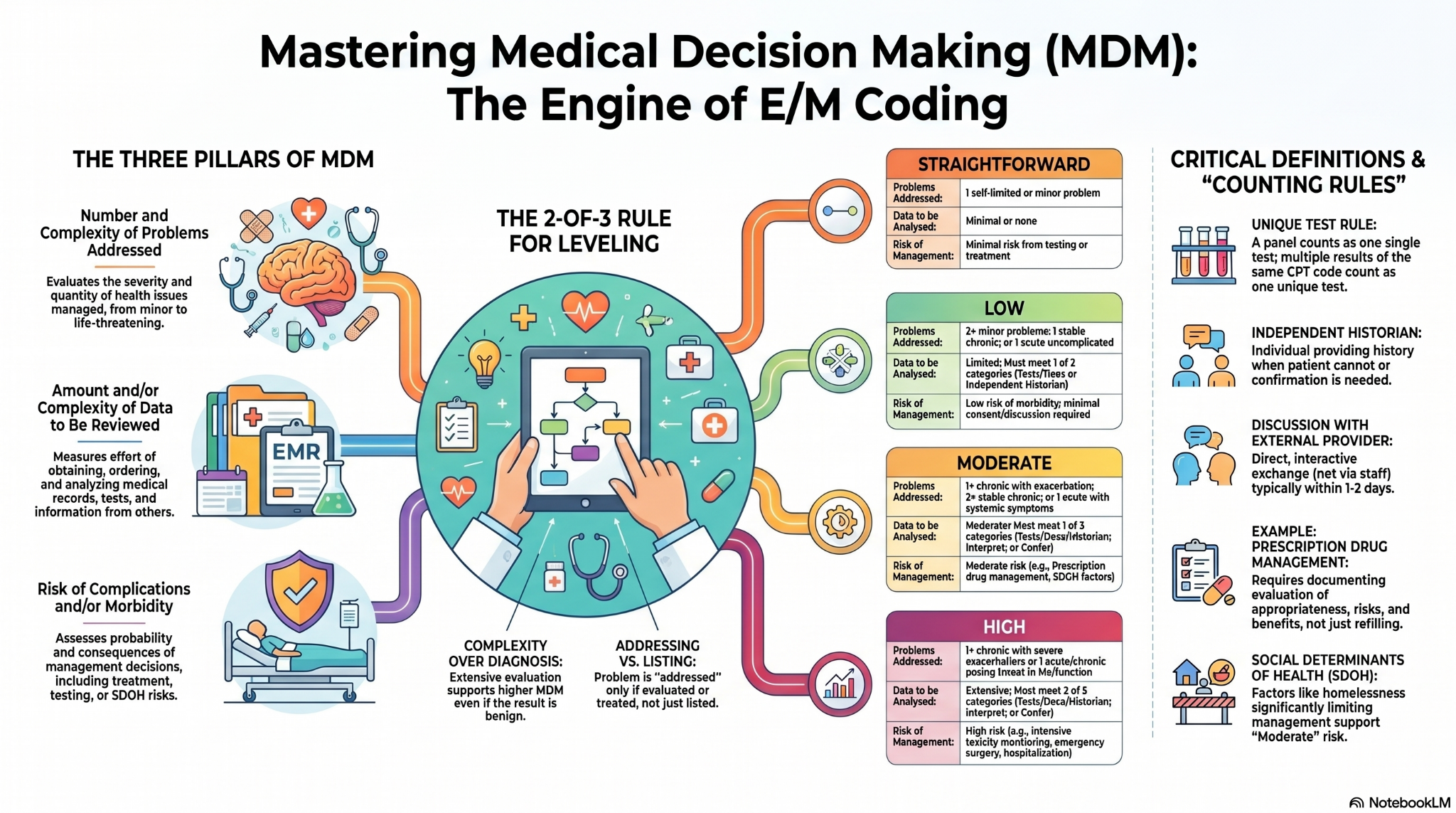
1️⃣ Number & Complexity of Problems Addressed
| Level | Problem Types | Examples |
|---|---|---|
| Straightforward | 1 self‑limited or minor problem | Viral URI, simple rash |
| Low | 2+ self‑limited problems OR 1 stable chronic illness OR 1 acute, uncomplicated illness | Controlled HTN, simple UTI |
| Moderate | 1+ chronic illness with exacerbation OR 2+ stable chronic illnesses OR undiagnosed new problem with uncertain prognosis OR acute illness with systemic symptoms | New abdominal pain, COPD flare |
| High | 1+ chronic illness with severe exacerbation OR acute or chronic illness posing threat to life or function | MI, stroke symptoms, sepsis |
2️⃣ Amount & Complexity of Data Reviewed
Data Categories
-
Category 1: Tests, documents, orders
- Review of labs, imaging, notes
- Ordering tests
- Independent historian
-
Category 2: Independent interpretation
- Provider interprets test (not separately billed)
-
Category 3: Discussion
- Discussion of management/test with external physician or qualified health professional
Data by Level
| Level | Requirements |
|---|---|
| Straightforward | Minimal or none |
| Low | Limited data (e.g., 1-2 tests ordered/reviewed) |
| Moderate | 1 of: • Category 1 (≥3 items) OR • Category 2 OR • Category 3 |
| High | 2 of: • Category 1 (≥3 items) AND • Category 2 AND/OR Category 3 |
3️⃣ Risk of Complications & Morbidity
| Level | Risk Examples |
|---|---|
| Straightforward | OTC meds, minor procedures |
| Low | Prescription drug management, minor surgery with no risk factors |
| Moderate | Decision for minor surgery with risk factors, escalation of care, chronic illness with exacerbation |
| High | Decision for major surgery, hospitalization, DNR decisions, severe exacerbations |
🧮 Putting It All Together: MDM Level Requirements
MDM level is based on 2 of the 3 elements:
- Problems
- Data
- Risk
| MDM Level | Problems | Data | Risk |
|---|---|---|---|
| Straightforward | Minimal | Minimal | Minimal |
| Low | Low | Limited | Low |
| Moderate | Moderate | Moderate | Moderate |
| High | High | Extensive | High |
🧠 Quick Audit Notes
- Document why a problem is worsening or severe
- Link tests to the problem being evaluated
- Clarify risk factors when prescribing meds
- Note shared decision‑making when applicable
- Capture external discussions clearly
🔗 Cross‑Links
- CIC Study Notes
- Coding Scenarios
- Audit Checklists
- Coding Career OS Canvas