From the Novitas Medicare website:
Modifiers
Modifiers indicate that a service or procedure performed has been altered by some specific circumstance, but not changed in its definition or code. They are used to add information or change the description of service to improve accuracy or specificity. Modifiers can be alphabetic, numeric or a combination of both, but will always be two digits.
Part B providers: Try our new modifier lookup tool - Find modifier details! Modifier Lookup Tool for JL - Part B only Modifier Lookup Tool for JH - Part B only
Some modifiers cause automated pricing changes, while others are used for information only. When selecting the appropriate modifier to report on your claim, please ensure that it is valid for the date of service billed.
If more than one modifier is needed, list the payment modifiers—those that affect reimbursement directly—first.
Payment modifiers include: -22, -26, -50, -51, -52, -53, -54, -55, -58, -62, -66, -78, -79, -80, -81, -82, AA, -AD, -AS, -TC, -QK, -QW, and -QY.
Informational or statistical modifiers (e.g., any modifier not classified as a payment modifier) should be listed after the payment modifier.
If multiple informational/statistical modifiers apply, you may list them in any order (as long as they are listed after payment modifiers).
Note: It is up to the provider to determine if a modifier applies, and then choose the most appropriate modifier based on medical documentation.
The definition of each modifier can be found within the document linked in the type of modifier column in the chart below.
For modifiers that can be used for more than one topic, please refer to the Additional HCPCS or other CPT for definition.
Additional HCPCS modifiers
| Modifier | Description | References |
|---|---|---|
| -AB | Audiology service furnished personally by an audiologist without a physician/NPP order for non-acute hearing assessment unrelated to disequilibrium, or hearing aids, or examinations for the purpose of prescribing, fitting, or changing hearing aids; service maybe performed once every 12 months, per beneficiary. | CMS MLN Connects Thursday March 16, 2023 Audiology Services |
| -AE | Registered dietician. | |
| -AF | Specialty physician. | |
| -AG | Primary physician. | |
| -AI | Principal physician of record. | Modifier AI fact sheet |
| -AK | Non-participating physician. | |
| -AM | Physician, team member service. | |
| -AO | Alternative payment method declined by a provider of service. | Affordable Care Act (ACA) Model 4 Bundled Payments for Care Improvement - Implementing Process for Provider Participation Decline - Modifier AO |
| -AT | Acute treatment. Chiropractors must bill the AT modifier when reporting HCPCS codes 98940, 98941, 98942 to indicate active / corrective treatment. Claims submitted without the AT modifier will be denied for maintenance therapy. Note: Effective with claims received on and after September 13, 2021, the AT modifier is no longer required on tetanus or rabies injection(s). | Chiropractor specialty guide Tetanus vaccineBilling and coding: Tetanus immunization (A58872) |
| -AZ | Physician providing a service in a dental health professional shortage area for the purpose of a promoting interoperability (PI) payment (formerly EHR Incentive payment). | |
| -BL | Special acquisition of blood and blood products. | Coding guidelines: Part A billing for blood and blood products |
| -CA | Procedure payable only in the inpatient setting when performed emergently on an outpatient who expires prior to admission. | CMS Internet Only Manual (IOM), Pub 100-04, Claims Processing Manual, Chapter 4, section 180.7 |
| -CB | Services ordered by a dialysis physician, as part of the ESRD beneficiary’s dialysis benefit, are not part of the composite rate and separately reimbursable. Note: Effective with dates of service on or after July 1, 2019, this modifier is no longer reported by independent laboratories requesting separate payment outside SNF CB for ESRD dialysis-related services. | MLN Matters article MM11061, Independent laboratory billing of laboratory tests for end-stage renal disease (ESRD) beneficiaries and the sunset of the CB modifier |
| -CG | Policy criteria applied. | RHC claims Rural Health Clinics (RHCs) HCPCS reporting requirement and billing updates New RHC reporting requirement - Modifier CG Rural health clinic specialty page ESRD claims Implementation of modifier CG for type of bill 72x End stage renal disease billing requirements End stage renal disease specialty page |
| -CR | Catastrophe / Disaster related. Required when item or service is impacted by emergency or disaster and Medicare payment for such item / service is conditioned on presence of “formal waiver.” | The use of the CR modifier and the DR condition code on disaster / emergency-related claims Additional editing for disaster related claims Medicare fee-for-service (FFS) response to the public health emergency on the Coronavirus (COVID-19) |
| -CS | Cost-sharing for specified COVID-19 testing-related services that result in an order for or administration of a COVID-19 test. Note: Cost-sharing does not apply for COVID-19 testing-related services, which are medical visits that: are furnished between March 18, 2020 and the end of the public health emergency (PHE); that result in an order for or administration of a COVID-19 test; are related to furnishing or administering such a test or to the evaluation of an individual for purposes of determining the need for such a test. For claims initially submitted without the -CS modifier providers/suppliers must notify their MAC by submitting a claim correction or clerical error reopening. | |
| -CT | Computed tomography services furnished using equipment that does not meet each of the attributes of the national electrical manufacturers association (NEMA) XR-29-2013 standard. | Payment reduction for computed tomography (CT) diagnostic imaging services |
| -DA | Oral health assessment by a licensed health professional other than a dentist. | |
| -ER | Items and services furnished by a provider-based off-campus emergency department. Note: Report this modifier on a UB-04 (CMS-1450) with every claim line for outpatient hospital services furnished in an off-campus provider-based emergency department. Critical access hospitals are not required to report this modifier. | January 2019 update of OPPS Hospital Off-Campus Outpatient Department Reporting Requirements |
| -ET | Emergency services | Skilled nursing facility (SNF) consolidated billing (CB) Common Working File (CWF) edit bypass instructions for hospital emergency room services spanning multiple service dates Skilled nursing facility consolidated billing edit C7252 |
| -FB | Item provided without cost to provider, supplier or practitioner, or full credit received for replaced device (examples, but not limited to, covered under warranty, replaced due to defect, free samples). | CMS IOM Pub. 100-04, Medicare Claims Processing Manual, Chapter 14, section 40.8 |
| -FC | Partial credit received for replaced device. | CMS IOM Pub. 100-04, Medicare Claims Processing Manual, Chapter 14, section 40.8 |
| -FS | Split or shared E/M visit. | Split/Shared Evaluation and Management visits MM12543, Internet-Only updates for critical care, split/shared E/M visits, teaching physicians and physician assistants |
| -FX | X-ray taken using films. | MM9727, Payment reduction for X-rays taken using film |
| -FY | X-ray taken using computed radiography technology/cassette-based imaging. | Change Request 10188, Payment reduction for X-rays taken using computer radiography |
| -G7 | Pregnancy resulted from rape or incest or pregnancy certified by physicians as life threatening. | |
| -GC | This service has been performed in part by a resident under the direction of a teaching physician. | CMS IOM, Pub 100-04, Claims Processing Manual, Chapter 12, section 100.1.8 |
| -GE | This service has been performed by a resident without the presence of a teaching physician under the primary care exception. Note: Modifier -GE for this purpose, use on all services except ambulance. | CMS IOM, Pub 100-04, Claims Processing Manual, Chapter 12, section 100.1.8 |
| -GF | Services rendered in a CAH by a nurse practitioner (NP), clinical nurse specialist (CNS) or physician assistant (PA). Modifier -GF only applies to Method II/optional providers Note: The GF modifier is not used for a certified registered nurse anesthetist (CRNA), services and will be returned to the provider. There is no benefit under Medicare law that authorizes payment to CRNs for their services. Accordingly, if a claim is received and it has the “GF” modifier for CRN services, no Medicare payment should be made. | CMS IOM, Pub 100-04, Claims Processing Manual, Chapter 4, section 250.2 |
| -GG | Performance and payment of screening mammogram and diagnostic mammogram on the same patient, same day. Note: This modifier is for tracking purposes only. | |
| -GJ | Opt-out physician / practitioner emergency or urgent services. | CMS IOM, Pub 100-02, Claims Processing Manual, Chapter 15, section 40.28 |
| -GU | Waiver of liability statement issued as required by a payer policy, routine notice. | |
| -J1 | Competitive acquisition program, no-pay submission for a prescription number. | MMA - Competitive acquisition program (CAP) for Part B drugs - Coding, testing, and implementation |
| -J2 | Competitive acquisition program, restocking of emergency drugs after emergency administration. | MMA - CAP for Part B drugs - Coding, testing, and implementation |
| -J3 | CAP drug not available through CAP as written, reimburse under ASP methodology. | MMA - CAP for Part B drugs - Coding, testing, and implementation |
| -JA | Administered intravenously. | |
| -JB | Administered subcutaneously. | |
| -JC | Skin substitute used as a graft. | |
| -JD | Skin substitute NOT used as a graft. | |
| -JG | Drug or biological acquired with 340B drug pricing program discount. Non-excepted off-campus provider-based departments of a hospital paid under the provider fee schedule are required to report modifier this modifier. | |
| -JW | Drug / biological discarded / not administered to any patient. | Drugs and biologicals Part B - Using the JW and JZ modifiers Drugs and biologicals Part A - Using the JW and JZ modifiers Medicare Program Discarded Drugs and Biologicals - JW Modifier and JZ Modifier Policy Frequently Asked Questions |
| -JZ | Zero drug amount discarded/not administered to any patient | Drugs and biologicals Part B - Using the JW and JZ modifiers Drugs and biologicals Part A - Using the JW and JZ modifiers Medicare Program Discarded Drugs and Biologicals - JW Modifier and JZ Modifier Policy Frequently Asked Questions |
| -KX | Requirements specified in the medical policy have been met | |
| -L1 | Separate payment for outpatient lab tests under the clinical laboratory fee schedule in the following circumstances: A hospital collects specimen and furnishes only the outpatient labs on a given date of service; or A hospital conducts outpatient lab tests that are clinically unrelated to other hospital outpatient services furnished the same day. Note: “Unrelated” means the laboratory test is ordered by a different practitioner than the practitioner who ordered other hospital outpatient services and for a different diagnosis. Hospitals should no longer use TOB 14X in these circumstances. | CMS IOM, Pub 100-04, Claims Processing Manual, Chapter 16, section 30.3 |
| -LU | Fractionalized payment CAR T-cell therapy This new modifier is in the January 2023 HCPCS update and is effective retroactively for use on claims with dates of service on or after January 1, 2022. | |
| -M2 | Medicare secondary payer for CAP | Assignment of dedicated Medicare secondary payer modifier introduced in change request (CR) 5332 (Transmittal 1088) |
| -PD | Diagnostic or related non-diagnostic item or service provided in a wholly owned or operated entity to a patient who is admitted as an inpatient within 3 days | SE20024 - FAQs on the 3-day payment window for services provided to outpatients who later are admitted as inpatients |
| -PI | PET tumor initial treatment strategy | FDG PET for solid tumors and myeloma Billing clarification for positron emission tomography (NaF-18) PET for identifying bone metastasis of cancer in the context of a clinical trial Positron emission tomography (FDG) for oncologic conditions and modifier usage |
| -PO | Services, procedures and/or surgeries furnished at off-campus provider-based outpatient departments. Report this modifier with every code for outpatient hospital services furnished in an off-campus provider-based outpatient department of a hospital. | Hospital off-campus outpatient department reporting requirements Off-campus provider-based department “PO” modifier FAQs |
| -PN | Non-excepted service provided at an off-campus, outpatient, provider-based department of a hospital | Hospital off-campus outpatient department reporting requirements |
| -PS | PET tumor subsequent treatment strategy | FDG PET for solid tumors and myeloma Billing clarification for positron emission tomography (NaF-18) PET for identifying bone metastasis of cancer in the context of a clinical trial Positron emission tomography (FDG) for oncologic conditions and modifier usage |
| -PT | Colorectal cancer screening test; converted to diagnostic test or other procedure | Waiver of coinsurance and deductible for preventive services, Section 4104 of the Affordable Care Act, removal of barriers to preventive services in Medicare Preventive services & screenings |
| -Q0 | Investigational clinical service provided in a clinical research study that is in an approved clinical research study. | Billing and coding of routine costs Transcatheter aortic valve replacement claim submission Clinical trials and devices Post-market approval studies Humanitarian device exemption (HDE) Pre-market approval, PMA post-approval extension studies, and pre-market notification 510(k) Percutaneous image-guided lumbar decompression (PILD) for lumbar spinal stenosis (LSS) PILD for LSS New HCPCS modifiers when billing for patient care in clinical research studies |
| -Q1 | Routine clinical service provided in a clinical research study that is in an approved clinical research study. | Billing and coding of routine costs Clinical trials and devices Post-market approval studies HDE New HCPCS modifiers when billing for patient care in clinical research studies |
| -Q3 | Live kidney donor surgery and related services Services will be reimbursed at 100% of the allowed charge as required in Section 1881 (d) of the Social Security Act. The following bullets are some reporting notes and tips for submitting kidney donor services: If more than two modifiers are required when reporting postoperative physician services furnished to live kidney donors, it is important that the -Q3 modifier is reported in the first modifier position. This is necessary to ensure that these services are reimbursed at 100%. Services are to be reported under the name and Medicare Beneficiary ID number of the recipient of the kidney donation. Procedure code 50320, donor nephrectomy from living donor 50547. | Billing for donor post-kidney transplant complication services introduced in CR 7523 transmittal (2334) CMS IOM, Pub 100-04, Claims Processing Manual, Chapter 3, section 90.1.3 |
| -Q4 | Service for ordering / referring physician qualifies as a service exemption for laboratory services. | |
| -Q5 | Service furnished by a substitute physician under a reciprocal billing arrangement. | Reciprocal billing and fee-for-time compensation arrangements |
| -Q6 | Service furnished by a locum tenens physician. | Reciprocal billing and fee-for-time compensation arrangements |
| -QJ | Services/items provided to a prisoner or patient in state or local custody, however the state or local government, as applicable, meets the requirements in 42 CFR 411. 4 (b) | CMS IOM, Pub. 100-04, Claims Processing Manual, Chapter 1, section 10.4 |
| Ordering professional consulted a qualified clinical decision support mechanism for this service and the related data was provided to the furnishing professional. | Appropriate use criteria for advanced diagnostic imaging - Voluntary participation and reporting period - Claims processing requirements - HCPCS modifier QQ | |
| -RD | Drug provided to beneficiary, but not, administrated incident-to. | |
| -RE | Furnished in full compliance with FDA-mandated REMS (risk evaluation and mitigation strategy). | |
| -SC | Medically necessary service or supply. | |
| -SF | Second opinion ordered by a Professional Review Organization per section 9401, P.L. 99-272 (100 % reimbursement - no Medicare deductible or coinsurance). | |
| -SS | Home infusion services provided in the infusion suite of the IV therapy provider. | |
| -SW | Services provided by a certified diabetes educator. | |
| -TB | Drug or biological acquired with 340B drug pricing program discount, reported for informational purposes. Note: Since rural sole community hospitals, children’s hospitals, and prospective payment system-exempt cancer hospitals are excepted from the 340B payment adjustment, these hospitals will report informational modifier “TB” for 340B-acquired drugs. | |
| -TC | Technical component: Under certain circumstances a charge may be made for the technical component alone. Under those circumstances the technical component charge is identified by adding modifier -TC to the usual procedure code number. This modifier must be reported in the first modifier field. | Modifier TC fact sheet Local contractor pricing - References |
| -TS | Follow-up service. | |
| -UJ | Services provided at night. | Updates to the 72X type of bill for home and self-dialysis training, retraining, and nocturnal hemodialysis |
| -UN | Two patients served: This modifier is needed when transportation of portable x-ray equipment (R0075) is billed. | CMS IOM, Pub. 100-04, Claims Processing Manual, Chapter 13, section 90.3 |
| -UP | Three patients served: This modifier is needed when transportation of portable X-ray equipment (R0075) is billed. | CMS IOM, Pub. 100-04, Claims Processing Manual, Chapter 13, section 90.3 |
| -UQ | Four patients served: This modifier is needed when transportation of portable X-ray equipment (R0075) is billed. | CMS IOM, Pub. 100-04, Claims Processing Manual, Chapter 13, section 90.3 |
| -UR | Five patients served: This modifier is needed when transportation of portable X-ray equipment (R0075) is billed. | CMS IOM, Pub. 100-04, Claims Processing Manual, Chapter 13, section 90.3 |
| -US | Six patients served: This modifier is needed when transportation of portable X-ray equipment (R0075) is billed. | CMS IOM, Pub. 100-04, Claims Processing Manual, Chapter 13, section 90.3 |
| -X1 | Continuous/broad services = For reporting services by clinicians who provide the principal care for a patient, with no planned endpoint of the relationship. | Reporting the HCPCS level II modifiers of the patient relationship categories and codes |
| -X2 | Continuous/focused services = For reporting services by clinicians whose expertise is needed for the ongoing management of a chronic disease or a condition that needs to be managed and followed for a long time. | Reporting the HCPCS level II modifiers of the patient relationship categories and codes |
| -X3 | Episodic/broad services = For reporting services by clinicians who have broad responsibility for the comprehensive needs of the patients, that is limited to a defined period and circumstance, such as a hospitalization. | Reporting the HCPCS level II modifiers of the patient relationship categories and codes |
| -X4 | Episodic/focused services = For reporting services by specialty focused clinicians who provide time-limited care. | Reporting the HCPCS level II modifiers of the patient relationship categories and codes |
| -X5 | Only as ordered by another clinician = For reporting services by a clinician who furnishes care to the patient only as ordered by another clinician. | Reporting the HCPCS level II modifiers of the patient relationship categories and codes |
| -XE | Separate encounter: A service that is distinct because it occurred during a separate encounter (subset of modifier -59). Note: Only use -XE to describe separate encounters on the same date of service | Modifiers 59 and X(EPSU) Modifier 59 CMS MLN Fact Sheet, Proper Use of Modifiers 59 & -X{EPSU} |
| -XP | Separate practitioner: A service that is distinct because it was performed by a different practitioner (subset of modifier -59). | Modifiers 59 and X(EPSU) Modifier 59 CMS MLN Fact Sheet, Proper Use of Modifiers 59 & -X{EPSU} |
| -XS | Separate structure: A service that is distinct because it was performed on a separate organ / structure (subset of modifier -59). | Modifiers 59 and X(EPSU) Modifier 59 CMS MLN Fact Sheet, Proper Use of Modifiers 59 & -X{EPSU} |
| -XU | Unusual non-overlapping service: The use of a service that is distinct because it does not overlap usual components of the main service (subset of modifier -59). | Modifiers 59 and X(EPSU) Modifier 59 CMS MLN Fact Sheet, Proper Use of Modifiers 59 & -X{EPSU} |
Advance beneficiary notice of noncoverage (ABN) modifiers
| Modifier | Description |
|---|---|
| -GA | Waiver of liability statement issued, as required by payer policy |
| -GX | Notice of liability issued, voluntary under payer policy |
| -GY | Item or service statutorily excluded, does not meet the definition of any Medicare benefit |
| -GZ | Item or service expected to be denied as not reasonable and necessary |
References
Advanced beneficiary notice of non-coverage
Fee for service advance beneficiary notice of noncoverage
Medicare advance beneficiary notices
Advanced diagnostic imaging appropriate use (AUC) modifiers
As announced in the CY 2024 Physician Fee Schedule (PPS), effective January 1, 2024, CMS is pausing efforts to implement the AUC program for reevaluation and rescinding the AUC regulations at 42 CFR 414.94, reserving this section for future use. CMS has not specified a timeframe within which implementation efforts will recommence. .
Effective January 1, 2024, providers and suppliers should no longer include AUC consultation information on Medicare FFS claims. However, claims containing AUC related codes with dates of service in 2023 and 2024 will continue to process. Codes include G1000 through G1024 and modifiers MA through MH and QQ.
CMS plans to end the above described HCPCS G codes and modifiers, effective December 31, 2024, to assist in claims processing and data analysis.
| Modifier | Definition |
|---|---|
| -MA | Ordering professional is not required to consult a clinical decision support mechanism due to service being rendered to a patient with a suspected or confirmed emergency medical condition. |
| -MB | Ordering professional is not required to consult a clinical decision support mechanism due to the significant hardship exception of insufficient internet access. |
| -MC | Ordering professional is not required to consult a clinical decision support mechanism due to the significant hardship exception of electronic health record or clinical decision support mechanism vendor issues. |
| -MD | Ordering professional is not required to consult a clinical decision support mechanism due to the significant hardship exception of extreme and uncontrollable circumstances. |
| -ME | The order for this service adheres to the appropriate use criteria in the clinical decision support mechanism consulted by the ordering professional. |
| -MF | The order for this service does not adhere to the appropriate use criteria in the qualified clinical decision support mechanism consulted by the ordering professional. |
| -MG | The order for this service does not have appropriate use criteria in the clinical decision support mechanism consulted by the ordering professional. |
| -MH | Unknown if ordering professional consulted a clinical decision support mechanism for this service, related information was not provided to the furnishing professional or provider. |
| Ordering professional consulted a qualified clinical decision support mechanism for this service, and the related data was provided to the furnishing professional. (effective July 1, 2018) |
References
Appropriate use criteria program MLN Matters article MM13485 - Appropriate Use Criteria for Advanced Diagnostic Imaging: CY 2024 Update
Anatomical modifiers
Anatomical modifiers include coronary artery, eye lid, finger, side of body, and toe.
Bilateral procedures
Bilateral indicator of 1 must be reported with 1 unit of service and modifier -50. The -50 modifier identifies the service as being performed on both sides of the body. Do not report anatomical modifiers in addition to modifier -50.
If more than one bilateral procedure was performed, report the services on one line, the number of units should be adjusted to reflect the number of bilateral procedures that are performed.
It is recommended that anatomical modifiers only be included when the service is performed unilaterally to show the additional services are not duplicates.
Coronary artery modifiers
Append one of the following modifiers to identify the coronary artery.
| Modifier | Description |
|---|---|
| -LC | Left circumflex coronary artery |
| -LD | Left anterior descending coronary artery |
| -LM | Left main coronary artery |
| -RC | Right coronary artery |
| -RI | Ramus intermedius |
Eye lid modifiers
Append one of the following modifiers to identify the upper or lower eye lid.
| Modifier | Description |
|---|---|
| -E1 | Upper left, eyelid |
| -E2 | Lower left, eyelid |
| -E3 | Upper right, eyelid |
| -E4 | Lower right, eyelid |
Finger modifiers
Append one of the following modifiers to identify the digit of the hand.
| Modifier | Description |
|---|---|
| -FA | Left hand, thumb |
| -F1 | Left hand, second digit |
| -F2 | Left hand, third digit |
| -F3 | Left hand, fourth digit |
| -F4 | Left hand, fifth digit |
| -F5 | Right hand, thumb |
| -F6 | Right hand, second digit |
| -F7 | Right hand, third digit |
| -F8 | Right hand, fourth digit |
| -F9 | Right hand, fifth digit |
Side of body modifiers
Use one of the anatomical specific modifiers to designate the area or part of the body which the procedure was performed.
| Modifier | Description |
|---|---|
| -LT | Left side (used to identify procedures performed on the left side of the body) |
| -RT | Right side (used to identify procedures performed on the right side of the body) |
Toe modifiers
Append one of the following modifiers to identify the digit of the foot.
| Modifier | Description |
|---|---|
| -TA | Left foot, great toe |
| -T1 | Left foot, second digit |
| -T2 | Left foot, third digit |
| -T3 | Left foot, fourth digit |
| -T4 | Left foot, fifth digit |
| -T5 | Right foot, great toe |
| -T6 | Right foot, second digit |
| -T7 | Right foot, third digit |
| -T8 | Right foot, fourth digit |
| -T9 | Right foot, fifth digit |
Note: If the anatomical modifiers can’t be described by using one of the above modifiers, reference Proper Use of Modifiers 59 &- X{EPSU}
References
Bilateral indicators Global surgery calculator (JH) (JL) Global surgery & related services Modifier 59 and new modifiers XE, XS, XP, XU Modifier 59 article Ways to avoid an appeal
Anesthesia modifiers
One of the modifiers listed below must be reported with anesthesia services to indicate who performed the anesthesia service. Modifiers may only be submitted with anesthesia procedure codes (i.e., CPT codes 00100-01999).
Note: CPT codes 01995 or 01996 are not recognized for time units and should not be submitted with time units in the quantity billed field.
Pricing modifiers (-AA, -QK, -AD, -QY, -QX and -QZ) should be placed in the first modifier field. If -QS modifier applies, it must be in the second modifier field.
If reporting multiple modifiers, the medical direction modifier should be listed first, followed by any additional modifiers that are needed.
When Billing for more than four concurrent anesthesia procedures, please review this article.
| Modifier | Description |
|---|---|
| -AA | Anesthesia services personally performed by the anesthesiologist |
| -AD | Supervision, more than four procedures |
| -QK | Medical direction of two, three, or four concurrent anesthesia procedures |
| -QX | Qualified non-physician anesthetist with medical direction by a physician |
| -QY | Medical direction of one CRNA/AA by an anesthesiologist |
| -QZ | Certified registered nurse anesthetist (CRNA) without medical direction by a physician |
Monitored anesthesia care
| Modifier | Description |
|---|---|
| -QS | Monitored anesthesia care (MAC) services (can be billed by a qualified nonphysician anesthetist or physician) |
| -G8 | Deep complex complicated, or markedly invasive surgical procedures |
| -G9 | Appended with an anesthesia code to indicate that the patient has a history of a severe cardiopulmonary condition |
| -P1 | A normal healthy patient |
| -P2 | A patient with mild systemic disease |
| -P3 | A patient with severe systemic disease |
| -P4 | A Patient with severe systemic disease that is a constant threat to life |
| -P5 | A moribund patient who is not expected to survive without the operation |
| -P6 | A declared brain-dead patient whose organs are being removed for donor purposes |
Teaching physician
| Modifier | Description | |
|---|---|---|
| -GC | These services have been performed by a resident under the direction of a teaching physician. Note: This modifier is reported by the teaching physician to indicate they rendered the service in compliance with the teaching physician requirements. The teaching anesthesiologist should report modifiers “-AA” and “-GC” (certification modifier). |
Other modifiers
The modifiers listed below can be reported in the 2nd position under appropriate circumstances in addition to any of the above-referenced modifiers.
| Modifier | Description |
|---|---|
| -23 | Unusual anesthesia Note: Using modifier -23 attests that proper documentation is on file to support the unusual anesthesia service. |
| -33 | Preventive services: When the primary purpose of the service is the delivery of an evidence based service in accordance with a U.S. Preventive Services Task Force A or B rating in effect and other preventive services identified in preventive services mandates (legislative or regulatory), the service may be identified by adding -33 to the procedure. |
Payment indications
Payment for services that meet the definition of ‘personally performed’ is calculated based on the base units (as defined by CMS) and time, in increments of 15-minute units.
Payment for services that meet the definition of ‘medically directed’ or ‘without medical direction’ is calculated based on the base units (as defined by CMS) and time, in increments of 15-minute units. Payment for services that meet the definition of ‘medically directed’ is based on 50 percent of the ‘personally performed’ rate.
References
CMS IOM Pub. 100-04, Medicare claims processing manual, Chapter 12, section 50 How anesthesia reimbursement is calculated LCD, L35049 - Monitored anesthesia care
Assistant at surgery modifiers
An assistant at surgery is a physician who actively assists the physician in charge of a case in performing a surgical procedure.
Global surgery rules do not apply.
| Modifier | Description |
|---|---|
| -AS | Physician assistant, nurse practitioner, or clinical nurse specialist services for assistant at surgery. |
| -80 | Assistant Surgeon: Surgical assistant services may be identified by adding the modifier -80 to the usual procedure number(s). |
| -81 | Minimum Assistant Surgeon: Minimum surgical assistant services are identified by adding modifier -81 to the usual procedure number. |
| -82 | Assistant Surgeon (when qualified resident surgeon not available): The unavailability of a qualified resident surgeon is a prerequisite for use of modifier -82 appended to the usual procedure code number(s). |
Assistant at surgery modifier fact sheet
- An assistant at surgery is a provider who actively assists the physician in charge of a case in performing a surgical procedure.
- A physician, nurse practitioner, physician assistant or clinical nurse specialist who is authorized to provide such services under state law can serve as an assistant at surgery.
- The “assistant at surgery” provides more than just ancillary services. The operative note should clearly document the assistant surgeon’s role during the operative session.
Facts
- Use the “-80” modifier when the assistant at surgery service was provided by a physician.
- Use the “-81” This modifier pertains to physician’s services only. Minimal surgical assistance may be identified by adding the modifier 81 to the usual procedure code and describes an assistant surgeon providing minimal assistance to the primary surgeon.
- Use the “-82” modifier when a qualified resident surgeon is not available in a teaching facility:
- The unavailability of a qualified resident surgeon is a prerequisite for use of this modifier and the service must have been performed in a teaching facility.
- The circumstance explaining that a resident surgeon was not available must be documented in the medical record. This modifier is not intended for use by non-physician providers.
- Use the modifier “-AS” for assistant at surgery services provided by a physician’s assistant (PA), nurse practitioner (NP), or clinical nurse specialist (CNS). The provider must accept assignment.
Reimbursement
Medicare reimburses services rendered for assistant at surgery by a physician performing as a surgical assistant at 16 percent of the Medicare Physician Fee Schedule Database (MPFSDB) amount.
Services rendered for assistant at surgery by non-physician providers (PA, NP, or CNS) are reimbursed at 85 percent of 16 percent (i.e., 13.6 percent) of the MPFSDB amount.
Assistant at surgery indicators
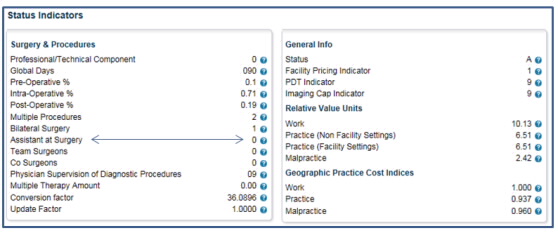
The Medicare physician fee schedule (MPFS)(JH) (JL) status indicators for assistant at surgery services should be used to determine if the procedure is allowed with the assistance of a second surgeon.
Status definitions
0 = Payment restrictions for assistants at surgery applies to this procedure unless supporting documentation is submitted to establish medical necessity.
Note: Supporting documentation must be submitted at the time of claim submission to established medical necessity and should clearly document the assistant surgeon’s role during the operative session.
1 = Statutory payment restriction for assistants at surgery applies to this procedure. Assistant at surgery may not be paid.
2 = Payment restrictions for assistants at surgery does not apply to this procedure. Assistant at surgery may be paid.
9 = Concept does not apply
Supporting documentation
Documentation is required when modifiers -80, -81, -82 and -AS modifiers are reported, and the payment indicator is a “0”.
Documentation must provide a clinical picture of the patient and include:
- The procedures or services performed and support the use of modifiers -80, -81, -82 and -AS
- The name of the assistant
- Evidence the assistant surgeon actively participated in the procedure
Clearly document the assistant’s role during the operative session:
- Assistant’s role provides more than ancillary services
Primary surgeon’s signature:
- The assistant is not required to sign the operative report, the primary surgeon’s signature is sufficient
- Modifier -82 requires the circumstance documented in the medical record that a resident surgeon was not available
- Claims with modifiers -80, -81, -82 and -AS should be submitted with required documentation following the Unsolicited Paperwork (PWK) process.
- The PWK is a process allowing providers to submit documentation with an initial claim:
- Detailed information is outlined in Submitting Unsolicited Paperwork (PWK) Segments for Electronic Claims
- Claims will be rejected when reporting modifiers -80, -81, -82 and -AS without supporting documentation. Rejected claims will need to be resubmitted using the instructions above for submitting documentation with your initial claim.
References
Assistant at surgery modifiers CMS IOM Pub.100-04, Medicare Claims Processing Manual, Chapter 12, section 20.4.3 CMS IOM, Publication 100-04, Medicare Claims Processing Manual, Chapter 12, section 100.1.7 Global surgery and related services Importance of documentation Assistant at surgery modifiers fact sheet
End stage renal disease and erythropoiesis stimulating agent modifiers
Claims for erythropoiesis stimulating agent (ESA) for end stage renal disease (ESRD) patients receiving dialysis in renal dialysis facilities reporting a hematocrit level exceeding 39.0% (or hemoglobin exceeding 13.0g/dL) shall also include modifier -ED or -EE.
For claims reporting hematocrit or hemoglobin levels exceeding monitoring threshold, the payment for the dose shall be reduced by 25% over the preceding month.
You may report that a dose reduction did occur in response to reported elevated hematocrit or hemoglobin level by adding -GS modifier on claim. If modifier -GS is not reported for hematocrit or hemoglobin levels exceeding the monitoring threshold, the covered dosage will be reduced by 25%.
Injections of ESA for ESRD beneficiaries must include a modifier indicating type of administration.
| Modifier | Description |
|---|---|
| -EA | ESA administered to treat anemia due to anti-cancer chemotherapy |
| -EB | ESA administered to treat anemia due to anti-cancer radiotherapy. |
| -EC | ESA administered to treat anemia not due to anti-cancer radiotherapy or anti-cancer chemotherapy |
ESRD billing modifiers
| Modifier | Description |
|---|---|
| -AX | Item furnished in conjunction with dialysis services *Effective for claim submission on or after July 1, 2026 the AX modifier is no longer used in payment calculations and is not required |
| -AY | Item or service furnished to an ESRD patient that is not for the treatment of ESRD |
| -ED | Hematocrit greater than 39.0% or hemoglobin greater than 13.0g/dL for 3 or more consecutive billing cycles immediately prior to and including the current billing cycle |
| -EE | Hematocrit greater than 39.0% or hemoglobin greater than 13.0g/dL for less than 3 consecutive billing cycles immediately prior to and including the current billing cycle |
| -EJ | Subsequent claims for a defined course of therapy, e.g., EPO, Sodium Hyaluronate, Infliximab |
| -EM | Emergency reserve supply for ESRD benefit only. In event that schedule was changed, provider should note changes in medical record and bill according to revised schedule. For patients beginning to self-administer an ESA at home receiving an extra month supply of drug, bill one-month reserve supply on one claim line and include this modifier. |
| -G1 | Most recent urea reduction ratio (URR) reading of less than 60 |
| -G2 | Most recent URR reading of 60 to 64.9 |
| -G3 | Most recent URR reading of 65 to 69.9 |
| -G4 | Most recent URR reading of 70 to 74.9 |
| -G5 | Most recent URR reading of 75 or greater |
| -G6 | ESRD patient for whom less than six dialysis sessions have been provided in a month |
| -GS | Dosage of Epoetin Alfa (EPO) or Darbepoetin Alfa has been reduced and maintained in response to hematocrit or hemoglobin level. |
| -JA | Administered intravenously |
| -JB | Administered subcutaneously |
| -JE | Administered via dialysate |
| -V5 | Any vascular catheter (alone or with any other vascular access) - Part A only modifier |
| -V6 | Arteriovenous graft (or other vascular access not including a vascular catheter) - Part A only modifier |
| -V7 | Arteriovenous fistula (or other vascular access not including a vascular catheter) - Part A only modifier |
| -V8 | Dialysis related infection present during the billing month - Part A only modifier |
| -V9 | No dialysis related infection present during the billing month - Part A only modifier |
Global surgery modifiers
The modifiers listed below are used by physicians to indicate a billed service is not part of a global surgical package and is eligible for separate reimbursement.
| Modifier | Description | References |
|---|---|---|
| -24 | Unrelated Evaluation and Management Service by the Same Physician or Other Qualified Health Care Professional During a Postoperative Period: The physician may need to indicate that an evaluation and management service was performed during a postoperative period for a reason(s) unrelated to the original procedure. This circumstance may be reported by adding the modifier 24 to the appropriate level of E/M service. | Modifier 24 Fact Sheet |
| -25 | Significant, Separately Identifiable Evaluation and Management Service by the Same Physician or Other Qualified Health Care Professional on the Same Day of the Procedure or Other Service: It may be necessary to indicate that on the day a procedure or service identified by a CPT code was performed, the patient’s condition required a significant, separately identifiable E/M service above and beyond the other service provided or be beyond the usual preoperative and postoperative care associated with the procedure that was performed. A significant, separately identifiable E/M service is defined or substantiated by documentation that satisfies the relevant criteria for the respective E/M service to be reported (see Evaluation and Management Services Guidelines for instructions on determining level of E/M service). The E/M service may be prompted by the symptom or condition for which the procedure and/or service was provided. As such, different diagnoses are not required for reporting of the E/M services on the same date. This circumstance may be reported by adding modifier 25 to the appropriate level of E/M service. Note: This modifier is not used to report an E/M service that resulted in a decision to perform major surgery. See modifier 57. For significant, separately identifiable non-E/M services, see modifier 59. | Modifier 25 Fact Sheet Modifier 25 Tips |
| -54 | Surgical Care Only: When one physician performs a surgical procedure and another provides preoperative and/or postoperative management, surgical services may be identified by adding the modifier 54 to the usual procedure code. Services billed with a 54 modifier will be reimbursed at the intraoperative allowance for the surgical procedure. The intraoperative allowance includes the one day preoperative care, the intraoperative service, as well as any in-hospital visits that are performed. | Post-Operative Co-Management, Modifiers 54 and 55 |
| -55 | Postoperative Management Only: When one physician performs the postoperative management and another physician has performed the surgical procedure, the postoperative component may be identified by adding the modifier 55 to the usual procedure number. | Post-Operative Co-Management, Modifiers 54 and 55 |
| -57 | Decision for Surgery: An evaluation and management service that resulted in the initial decision to perform the surgery may be identified by adding modifier 57 to the appropriate level of E/M service. | Modifier 57 Fact Sheet |
| -58 | Staged or Related Procedure or Service by the Same Physician or Other Qualified Health Care Professional During the Postoperative Period: It may be necessary to indicate that the performance of a procedure or service during the postoperative period was (a) planned or anticipated (staged); (b) more extensive than the original procedure; or (c) for therapy following a surgical procedure. This circumstance may be reported by adding the modifier 58 to the staged or related procedure. Note: For treatment of a problem that required a return to the operating or procedure room (e.g., unanticipated clinical condition), see modifier 78. | Modifier 58 Fact Sheet |
| -78 | Unplanned Return to the Operating/Procedure Room by the Same Physician or Other Qualified Health Care Professional Following Initial Procedure for a Related Procedure During the Postoperative Period: It may be necessary to indicate that another procedure was performed during the postoperative period of the initial procedure (unplanned procedure following initial procedure). When this procedure is related to the first and requires the use of an operating room, it may be reported by adding modifier 78 to the related procedure. (For repeat procedures, see modifier 76). | Modifier 78 Fact Sheet |
| -79 | Unrelated Procedure by the Same Physician or Other Qualified Health Care Professional During the Postoperative Period: The physician may need to indicate that the performance of a procedure or service during the postoperative period was unrelated to the original procedure. This circumstance may be reported by using the modifier 79. (For repeat procedures on the same day, see modifier 76). | Modifier 79 Fact Sheet |
| -FT | Unrelated E/M visit during a postoperative period, or on the same day as a procedure or another E/M visit. Report modifier FT: For critical care visits that are unrelated to the surgical procedure but performed on the same day; or When critical care services provided during a global surgical period are unrelated to a surgical procedure. | Critical care services MLN Matters article MM12550, Internet-Only updates for critical care E/M services MLN Matters article MM12543, Internet-Only updates for critical care, split/shared E/M visits, teaching physicians and physician assistants CMS, IOM Pub. 100-04, Medicare Claims Processing Manual, Chapter 12, Section 30.6.18 |
Visit our global surgery calculator (JH) (JL) to determine when the global period ends for a surgical procedure.
Hospice modifiers
| Modifier | Description |
|---|---|
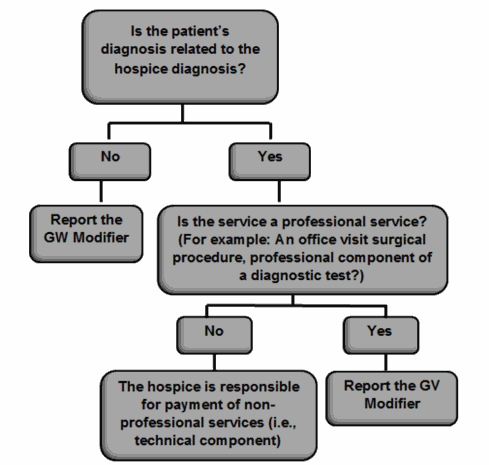
| -GV | Attending physician not employed or paid under arrangement by the patient’s hospice provider |
| -GW | Service not related to the hospice patient’s terminal condition |
Decision trees for hospice billing
The following decision trees should be used to determine when the services of a hospice patient should be covered and when to report the appropriate modifiers.
Billing physician is the attending physician
All other providers
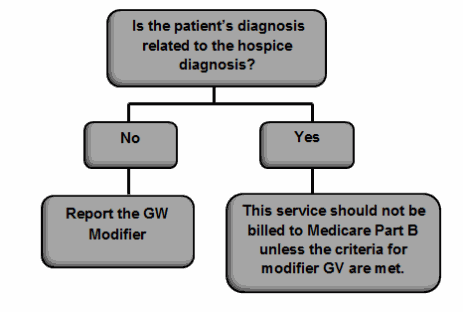
Note: If submitting charges not related to hospice on a UB-04 (or 837I electronic), append condition code 07 (treatment of a non-terminal condition for a hospice patient) along with the -GW modifier.
References
CMS IOM Pub. 100-04, Claims Processing Manual, Chapter 11, section 40 Provider specialty: Hospice
Other CPT Modifiers
| Modifier | Description | References |
|---|---|---|
| -26 | Professional component | Modifier 26 Fact Sheet Medicare physician fee schedule payment policy indicators |
| -27 | Multiple outpatient hospital evaluation and management encounters on the same date. | Modifier 27 Fact Sheet |
| -33 | Preventive services When the primary purpose of the service is the delivery of an evidence-based service in accordance with a US Preventive Services Task Force A or B rating in effect or is another preventive services identified in preventive services mandates (legislative or regulatory), the service may be identified by adding 33 to the procedure. For separately reported services specifically identified as preventive, the modifier should not be used. | Advanced Care Planning Medicare Preventive Services |
| -59 | Distinct procedural service Under certain circumstances, it may be necessary to indicate that a procedure or service was distinct or independent from other non-E/M services performed on the same day. Modifier 59 is used to identify procedures or services, other than E/M services, that are not normally reported together but are appropriate under the circumstances. Documentation must support a different session, different procedure or surgery, different site or organ system, separate incision or excision, separate lesion, or separate injury (or area in injury in extensive injuries) not ordinarily encountered or performed on the same day by the same individual. However, when another already established modifier is appropriate it should be used rather than modifier 59. Modifier 59 should only be used if there is no other more descriptive modifier available. Note: Modifier 59 should not be appended to an E/M service. To report a separate and distinct E/M service with a non-E/M service performed on the same date, see modifier 25. | Modifier 59 Fact Sheet Modifiers 59 and the X (EPSU) Proper Use of Modifiers 59, XE, XP, XS & XU |
| -76 | Repeat procedure or service by same physician or other qualified healthcare professional It may be necessary to indicate that a procedure or service was repeated subsequent to the original procedure or service. This circumstance may be reported by adding the modifier 76 to the repeated procedure or service. | Modifier 76 Fact Sheet |
| -77 | Repeat procedure by another physician or other qualified healthcare professional The physician may need to indicate that a basic procedure or service performed by another physician had to be repeated. This situation may be reported by adding modifier 77 to the repeated procedure or service. | Modifier 77 Fact Sheet Using modifier 77 correctly to report repeat procedures by different providers Claims and appeals for CPT 93010 performed in emergency room setting |
| -96 | Habilitative services When a service or procedure that may be either habilitative or rehabilitative in nature is provided for habilitative purposes, the physician or other qualified health care professional may add modifier 96 to the service or procedure code to indicate that the service or procedure provided was a habilitative service. Habilitative services help an individual learn skill and functioning for daily living that the individual has not yet developed, and then keep and/or improve those learned skills. Habilitative services also help an individual keep, learn, or improve skills and functioning for daily living. (Informational only) | January 2018 Integrated Outpatient Code Editor (I/OCE) Specifications Version 19.0 |
| -97 | Rehabilitative services When a service or procedure that may be either habilitative or rehabilitative in nature is provided for rehabilitative purposes, the physician or other qualified health care professional may add modifier 97 to the service or procedure code to indicate that the service or procedure provided was a rehabilitative service. Rehabilitative services help an individual keep, get back, or improve skills and functioning for daily living that have been lost or impaired because the individual was sick, hurt, or disabled. (Informational only) | January 2018 Integrated Outpatient Code Editor (I/OCE) Specifications Version 19.0 |
Podiatry Class Findings Modifiers
Modifiers -Q7, -Q8, and -Q9 are to be used to bill podiatric services.
| Modifier | Description |
|---|---|
| -Q7 | One Class A Finding |
| -Q8 | Two Class B Findings |
| -Q9 | One Class B and Two Class C Findings |
Class Findings
Class A:
- Non-traumatic amputation of foot or integral skeletal portion thereof
Class B:
- Absent posterior tibial pulse
- Absent dorsalis pedis pulse
- Advanced trophic changes (at least three of the following):
- Decrease or absence of hair growth
- Nail thickening
- Skin discoloration
- Thin and shiny skin texture
- Rubor or redness of skin
Class C:
- Claudication
- Temperature changes (cold feet)
- Edema
- Paresthesia (abnormal spontaneous sensations in feet)
- Burning
For more information on podiatry services and class findings modifiers, please refer to our Routine Foot Care article.
Quality Reporting Incentive Programs Modifiers
The Merit-based Incentive Payment System (MIPS), formerly Physician Quality Reporting System (PQRS) program encourages individual eligible professionals (EPs) and group practices to report information on the quality of care to Medicare. It’s an opportunity for participating EPs and group practices to assess the quality of care they provide to their patients, helping to ensure that patients get the right care at the right time.
| Modifier | Definition |
|---|---|
| -1P | Performance Measure Exclusion Modifier Due to Medical Reasons |
| -2P | Performance Measure Exclusion Modifier Due to Patient Choice |
| -3P | Performance Measure Exclusion Modifier Due to System Reasons |
| -8P | Performance Measure Reporting Modifier - Action Not Performed, Reason Not Otherwise Specified |
Health Professional Shortage Area and Physician Scarcity Area Modifiers
The Medicare program provides incentive payments to physicians who render services in a Health Professional Shortage Area (HPSA).
| Modifier | Definition |
|---|---|
| -AQ | Service performed in a Health Professional Shortage Area. This modifier is used by physicians to indicate the services reported were rendered in a qualified HPSA and are eligible for the 10% incentive payment. |
| -AR | Physician providing services in a physician scarcity area. |
Patient Relationship Categories and Codes
The Medicare Access and CHIP Reauthorization act of 2018 requires the development of PRC codes to help the attribution of patients and episodes to one or more physicians or applicable practitioners (clinicians) for purposes of cost measurement.
The Centers for Medicare & Medicaid Services (CMS) has several goals for the voluntary reporting period:
For clinicians to gain familiarity with the categories and experience submitting the codes
To collect data on the use and submission of the codes for analyses to inform the potential future use of these codes in cost measure attribution methodology in the Quality Payment Program
The codes are currently in a voluntary reporting period. Whether and how the codes are reported on claims will not affect Medicare reimbursement. For now, the modifiers have no impact on beneficiaries.
As of January 1, 2018, Medicare Part B Merit-Based Incentive Payment System-eligible clinicians may now report their patient relationships on Medicare claims using the PRC codes. Reporting of these modifiers will be mandatory in the near future and CMS advises clinicians to participate during the voluntary reporting period to ease transition.
| Modifier | Definition | Reporting Services |
|---|---|---|
| -X1 | Continuous/Broad services | For reporting services by clinicians who provide the principal care for a patient, with no planned endpoint of the relationship |
| -X2 | Continuous/Focused services | For reporting services by clinicians whose expertise is needed for the ongoing management of a chronic disease or a condition that needs to be managed and followed for a long time |
| -X3 | Episodic/Broad services | For reporting services by clinicians who have broad responsibility for the comprehensive needs of the patients, that is limited to a defined period and circumstance, such as a hospitalization. |
| -X4 | Episodic/Focused services | For reporting services by specialty focused clinicians who provide time-limited care. The patient has a problem, acute or chronic, that will be treated with surgery, radiation, or some other type of generally time-limited intervention |
| -X5 | Only as Ordered by Another Clinician | For reporting services by a clinician who furnishes care to the patient only as ordered by another clinician. This patient relationship category is reported for patient relationships that may not be adequately captured in the four categories described above |
Appropriate Use Criteria (AUC)
Effective January 1, 2020 (the start of the AUC program Educational and Operations Testing Period) the modifiers listed in the chart below will be accepted when used to report AUC for Advanced Diagnostic Imaging Services.
| Modifier | Definition |
|---|---|
| -MA | Ordering professional is not required to consult a clinical decision support mechanism due to service being rendered to a patient with a suspected or confirmed emergency medical condition. |
| -MB | Ordering professional is not required to consult a clinical decision support mechanism due to the significant hardship exception of insufficient internet access. |
| -MC | Ordering professional is not required to consult a clinical decision support mechanism due to the significant hardship exception of electronic health record or clinical decision support mechanism vendor issues. |
| -MD | Ordering professional is not required to consult a clinical decision support mechanism due to the significant hardship exception of extreme and uncontrollable circumstances. |
| -ME | The order for this service adheres to the appropriate use criteria in the clinical decision support mechanism consulted by the ordering professional. |
| -MF | The order for this service does not adhere to the appropriate use criteria in the qualified clinical decision support mechanism consulted by the ordering professional. |
| -MG | The order for this service does not have appropriate use criteria in the clinical decision support mechanism consulted by the ordering professional. |
| -MH | Unknown if ordering professional consulted a clinical decision support mechanism for this service, related information was not provided to the furnishing professional or provider. |
References
Health Professional Shortage Area (HPSA) Health Professional Shortage Area / Surgical Incentive Payment Program Merit-based Incentive Payment System (MIPS), formerly Physician Quality Reporting System (PQRS) MLN Matters® Article, MM9342 - 2016 Annual Update for the Health Professional Shortage Area (HPSA) Bonus Payments MLN Matters® Article, MM9781 - 2017 Annual Update for the Health Professional Shortage Area (HPSA) Bonus Payments MLN Matters® Article, MM11259 - Reporting the HCPCS Level II Modifiers of the Patient Relationship Categories and Codes MLN Matters® Article, MM11268 - Appropriate Use Criteria (AUC) for Advanced Diagnostic Imaging - Educational and Operations Testing Period - Claims Processing Requirements Quality Payment Program
Surgical modifiers
| Modifier | Description |
|---|---|
| 22 | Increased procedural services: When the work required to provide a service is substantially is greater than typically required, it may be identified by adding modifier -22 to the usual procedure code. Documentation must support the substantial additional work and the reason for the additional work (i.e., increased intensity, time, technical difficulty of procedure, and severity of patient’s condition, physical and mental effort required). Note: This modifier should not be appended to an E/M service. It should only be reported with procedure codes that have a global period of 0, 10, or 90 days. Proper use of modifier 22 |
| 50 | Bilateral procedure: Unless otherwise identified in the listings, bilateral procedures that are performed at the same operative session should be identified by adding the modifier -50 to the appropriate five-digit code. Modifier 50 fact sheet Bilateral indicators |
| 51 | Multiple procedures: When multiple procedures, other than E/M services, physical medicine and rehabilitation services or provision of supplies (e.g., vaccines), are performed at the same session by the same provider, the primary procedure or service may be reported as listed. The additional procedure(s) or service(s) may be identified by appending the modifier -51 to the additional procedure or service code(s). Note: This modifier should not be appended to designated “add-on” codes. Modifier 51 fact sheet |
| 52 | Reduced services: Under certain circumstances a service or procedure is partially reduced or eliminated at the physician’s discretion. Under these circumstances the service provided can be identified by its usual procedure number and the addition of the modifier -52, signifying that the service is reduced. This provides a means of reporting reduced services without disturbing the identification of the basic service. Modifier 52 fact sheet Top provider inquiries - unprocessable Part B FAQs - billing |
| 53 | Discontinued procedure: Under certain circumstances, the physician may elect to terminate a surgical or diagnostic procedure. Due to extenuating circumstances or those that threaten the well-being of the patient, it may be necessary to indicate that a surgical or diagnostic procedure was started but discontinued. This circumstance may be reported by adding the modifier -53 to the code reported by the physician for the discontinued procedure. Modifier -53 is used for “unusual (discontinued) circumstances”. Under certain circumstances, the physician may elect to terminate a surgical or diagnostic procedure due to extenuating circumstances that may threaten the well-being of the patient. In many instances, attachments, medical records, etc. are not required to be sent in if an explanation for the discontinuation is in the narrative field of the claim. For example, submit “discontinued due to elevated blood pressure”. When additional information to support the use of the -53 modifier cannot be contained in the narrative of the claim, additional documentation may be submitted. Modifier 53 fact sheet Top provider inquiries - unprocessable claims Incomplete colonoscopy billing requirements |
| 62 | Two surgeons: When two surgeons work together as primary surgeons performing distinct part(s) of a procedure, each surgeon should report his/her distinct operative work by adding modifier -62 to the procedure code and any associated add-on code(s) for that procedure as long as both surgeons continue to work together as primary surgeons. Modifier 62 fact sheet |
| 66 | Surgical team: Under some circumstances, highly complex procedures (requiring the concomitant services of several physicians, often of different specialties, plus other highly skilled, specialty trained personnel and various types of complex equipment) are carried out under the “surgical team” concept. Such circumstances may be identified by each participating physician with the addition of the modifier -66 to the basic procedure number used for reporting services. Documentation establishing that a surgical team was medically necessary is required for certain services identified by CMS. All claims for team surgeons must contain sufficient information i.e., operative reports, to allow pricing “by report”. Modifier 66 fact sheet |
| 73 | Discontinued out-patient hospital/ ASC procedure prior to the administration of anesthesia. Due to extenuating circumstances or threaten patient well-being: Prior to procedure started/patient’s surgical preparation (including sedation or taken to procedure room) Prior to administration of anesthesia (local, regional block or general). For physician reporting of a discontinued procedure, see modifier -53. Modifier 73 fact Sheet |
| 74 | Discontinued out-patient hospital/ASC procedure after administration of anesthesia: Due to extenuating circumstances, or those that threaten the well-being of the patient, the physician may terminate a surgical or diagnostic procedure after the administration of anesthesia (local, regional block(s) or general) or after the procedure was started (incision made, intubation started, scope inserted, etc.). Under these circumstances, the procedure started but terminated can be reported by its usual procedure number and the addition of the modifier -74. Note: The elective cancellation of a service prior to the administration of anesthesia and/or surgical preparation of the patient should not be reported. For physician reporting of a discontinued procedure, see modifier -53. Modifier 74 fact Sheet |
| PA | Surgical or otherwise invasive procedure on the wrong body part. Append the surgical or invasive procedure code performed incorrect body part. Note: CMS does not pay for service performed on the wrong part. MLN Matters article MM6718, Requirements to prevent the misuse of modifiers PA, PB and PC on incoming claims |
| PB | Surgical or otherwise invasive procedure on the wrong patient. Append the surgical or invasive procedure code performed on the incorrect patient Note: CMS does not pay for service performed on the incorrect patient. MLN Matters article MM6718, Requirements to prevent the misuse of modifiers PA, PB and PC on incoming claims |
| PC | Wrong surgery or other invasive procedure on patient. Append the surgical or invasive procedure code performed on the patient, when it was not the correct patient Note: CMS does not pay for an incorrect service performed on a patient. MLN Matters article MM6718, Requirements to prevent the misuse of modifiers PA, PB and PC on incoming claims |
Telehealth service modifiers
Telehealth modifiers must be submitted with distant site telehealth services. Generally, interactive audio and video communications must be used to permit real-time communication between distant site physician/practitioner and patient. Patient must be present and participating in telehealth visit.
A list of telehealth services is available on the CMS website.
| Modifier | Description | Additional Information |
|---|---|---|
| 93 | Telehealth modifier defined as “synchronous telemedicine service rendered via telephone or other real-time interactive audio-only telecommunications system.” | Modifier -93 is used for audio-only communication: Permitted for patients in their home if patient does not have: Technical capacity Availability of real-time audio and visual interactive technology Permitted for patients in their home if patient does not: Consent to the use of 2- way, audio/video technology Opioid Treatment Programs (OTPs) report on claims for intake activities, periodic assessments, counseling and therapy provided for audio-only technology: Reference: Opioid Treatment Programs Claims RHCs and FQHCs can report either modifier -93 or -FQ for services provided by audio-only technology. |
| 95 | Telehealth modifier defined as synchronous telemedicine service rendered via real-time Interactive audio and video telecommunications system. | Use modifier -95 for: Outpatient therapy services provided via telehealth by qualified physical therapists, occupational therapists, or speech language pathologists employed by hospitals Opioid Treatment Programs (OTPs) report on claims for intake activities, periodic assessments and counseling and therapy provided for using audio-video technology: Reference: Opioid Treatment Programs Claims |
| FQ | The service was furnished using audio-only communication technology. | This modifier can only be used by RHCs and FQHCs |
| G0 (zero) | Telehealth services furnished for purposes of diagnosis, evaluation, or treatment of symptoms of an acute stroke. | Valid for: Telehealth distant site codes billed with place of service (POS) code 02; or CAH method II (revenue codes 096X, 097X, or 098X); or Telehealth originating site facility fee, billed with HCPCS code Q3014. |
| GQ | Telehealth service rendered via asynchronous telecommunications system. | Certifying the collection and transmission of the asynchronous medical file at the distant site from a federal telemedicine demonstration conducted in Alaska or Hawaii. |
| GT | Telehealth service via interactive audio and video telecommunication systems. | Only allowed on institutional claims billed by CAH method II providers. |
References
Medicare Learning Network (MLN) Booklet: Telehealth & Remote Monitoring Telehealth.HHS.gov Telehealth FAQ Calendar Year 2026 Telehealth services List of Telehealth Services MM14315 - Medicare Physician Fee Schedule Final Rule Summary: CY 2026 MM13887 - Medicare Physician Fee Schedule Final Rule Summary: CY 2025 Change request 10152, Elimination of the GT Modifier for Telehealth Services CMS IOM Pub. 100-04 Claims Processing Manual, Chapter 12, sections 190 - 190.7 CMS IOM Pub. 100-04 Medicare Claims Processing Manual, Chapter 39, section 30.5 Change Request 10583, Revisions to the Telehealth Billing Requirements for Distant Site Services Change Request 10883, New Modifier for Expanding the Use of Telehealth for Individuals with Stroke Opioid Treatment Programs Medicare Billing & Payment Provider Specialty: Telehealth services
Therapy modifiers
Therapy modifiers indicate the discipline of the plan of care.
| Occupational therapy modifiers | |
|---|---|
| Modifier | Description |
| -CO | Outpatient physical therapy services furnished in whole or in part by a occupational therapist assistant. |
| -GO | Service delivered personally by an occupational therapist or under an outpatient occupational therapy plan of care. |
When reporting modifier -CO, the -GO modifier should also be submitted to identify the services furnished under an OT plan of care. Note: The -CO modifier is not applicable to claims from critical access hospitals.
| Physical therapy modifiers | |
|---|---|
| Modifier | Description |
| -CQ | Outpatient physical therapy services furnished in whole or in part by a physical therapist assistant. |
| -GP | Service delivered personally by a physical therapist or under an outpatient physical therapy plan of care |
When reporting modifier -CQ, the -GP modifier should also be submitted to identify the services furnished under a PT plan of care. Note: The -CQ modifier is not applicable to claims from critical access hospitals.
| Speech language pathology modifiers | |
|---|---|
| Modifier | Description |
| -GN | Service delivered personally by a speech-language pathologist or under an outpatient speech-language pathology plan of care |
Therapy threshold amount
| KX modifier therapy threshold amount | |
|---|---|
| Modifier | Description |
| -KX | Requirements specified in the medical policy have been met |
Note: The -KX modifier is used to confirm that services are medically necessary as justified by appropriate documentation in the medical record once the threshold amount has been met. There is one threshold amount for PT and SLP services combined and a separate threshold amount for OT services. Medicare will deny your claims for therapy services above these amounts without the -KX modifier.
References
Coding guidelines: Part A outpatient therapy billing at a glance New modifiers to identify occupational therapy (OT) and physical therapy (PT) services provided by a therapy assistant Outpatient rehabilitation Frequently Asked Questions (FAQs)-Part A Physical Therapy FAQs-Part B Provider Specialty: Therapy - Part A Provider Specialty: Rehabilitation services
There are times when coding and modifier information issued by CMS differs from the American Medical Association regarding the use of modifiers. A clear understanding of Medicare’s rules and regulations is necessary to assign the appropriate modifier.
Examples of when modifiers may be used:
- Identification of professional or technical only components.
- Repeat services by the same or different provider.
- An increased, reduced, or unusual service.
- Billing for components of a global surgical package.
- Identification of a specific body area.
- To designate a bilateral procedure.
- Identification of service in a clinical trial.