Atrial fibrillation (AF or AFib) is the most common sustained cardiac arrhythmia, characterized by rapid, chaotic, and disorganized electrical impulses originating from multiple ectopic foci throughout the atria — most frequently triggered by pulmonary vein firing — that replace the normal coordinated P-wave activity with an irregularly irregular ventricular response. On ECG, AF presents as absent P waves, an irregularly irregular rhythm, and a fibrillatory baseline. AF is classified by duration and reversibility into four clinically coded types: paroxysmal (self-terminating within 7 days), persistent (lasting >7 days; subdivided into longstanding persistent [>12 months] and other persistent), permanent (ongoing AF where rhythm control is no longer pursued), and chronic/long-standing (collectively overlapping with permanent in ICD-10-CM). The clinical consequences of AF center on two main threats: thromboembolism — particularly ischemic stroke — from stasis and clot formation in the left atrial appendage (LAA), and tachycardia-induced cardiomyopathy from sustained rapid ventricular rates. For AAPC-certified inpatient profee coders, AF type specificity is mandatory — the ICD-10-CM code set has distinct billable codes for each AF subtype, and defaulting to unspecified (I48.91) when the type is documented is a chronic CDI gap. Additionally, AF is a high-impact DRG driver: it serves as a principal diagnosis in DRGs 308-310 and as a significant comorbidity/complication (MCC/CC) in virtually every cardiac and non-cardiac DRG.
”Process of; state of” — a suffix forming abstract nouns of action or condition
The term atrium (plural atria) entered anatomical Latin from the Roman architectural term for an entrance hall — the dark, soot-stained foyer of a Roman home (āter = black, dark), which anatomists applied to the upper heart chambers as blood’s ”** **.” The word fibrillation was coined in 1842 to describe “the state of being arranged in fibrils,” and by 1882 was applied specifically to the quavering of cardiac muscle fibers contracting in a disorganized, ineffective pattern. The compound “atrial fibrillation” entered clinical use around 1905-1910, coinciding with the early development of the electrocardiograph by Willem Einthoven. The older term auricular fibrillation (from Latin auricula = “little ear,” the historical name for the atrial appendages) was used interchangeably through much of the 20th century and still appears in older literature.
🔀 ALIASES / ALTERNATE TERMS
Term
Relationship
AF
Standard clinical abbreviation; acceptable in all documentation contexts
AFib
Common clinical shorthand; widely used in nursing and hospitalist notes
A-Fib
Lay-clinical hybrid; common in patient education and problem lists
Auricular fibrillation
Historical/obsolete term; “auricle” = atrial appendage; do NOT use for ICD-10 coding
Paroxysmal AFib / PAF
Subtype; self-terminating ≤7 days; coded I48.0
Persistent AFib
Subtype; >7 days; requires further specificity — longstanding vs. other; coded I48.11 or I48.19
Longstanding persistent AFib
Subtype; persistent >12 months; coded I48.11
Permanent AFib
Subtype; rhythm control abandoned by mutual provider-patient decision; coded I48.21
Chronic AFib
ICD-10-CM grouping term; coded I48.20 (unspecified) or I48.21 (permanent)
Atrial flutter
Distinct but related arrhythmia — organized macro-reentrant circuit; coded I48.3 (typical) or I48.4 (atypical); do NOT conflate with AFib
Lone AFib
AF without structural heart disease or identifiable cause; no separate ICD-10 code — code by type
Left atrial appendage (LAA) — primary site of thrombus formation in AF; source of most AF-related embolic strokes; targeted by WATCHMAN device (CPT 33340)
Cardioversion — restoration of sinus rhythm via synchronized electric shock (92960 external) or pharmacologic agents; required pre-procedure anticoagulation documentation
Anticoagulation — mainstay of stroke prevention in AF; document agent type (warfarin, NOAC/DOAC) — supports Z79.01 (long-term anticoagulant use) as additional diagnosis
Rate control vs Rhythm control — two therapeutic strategies; rate control = control ventricular response (beta-blockers, calcium channel blockers, digoxin); rhythm control = restore/maintain sinus rhythm (antiarrhythmics, cardioversion, ablation)
Tachycardia-induced cardiomyopathy — reversible cardiomyopathy from sustained rapid ventricular rate in uncontrolled AF; code with heart failure if present (I50.x)
Wolff-Parkinson-White syndrome (WPW) — accessory pathway disorder; AF in WPW is a medical emergency — avoid AV nodal blocking agents; separate ICD-10 code I45.6
Sick sinus syndrome — SA node dysfunction; commonly coexists with AF (tachy-brady syndrome); coded I49.5
Ischemic stroke — most feared complication of AF; AF-related strokes tend to be more severe and disabling; code stroke first, AF as additional diagnosis
Heart failure — both a cause and consequence of AF; document type (systolic/diastolic, acute/chronic, left/right) for CC/MCC capture
Electrophysiology (EP) study — diagnostic catheterization to map arrhythmia mechanism; CPT 93620; foundation for ablation planning
Transesophageal echocardiogram (TEE) — used pre-cardioversion and intra-WATCHMAN procedure to evaluate LAA thrombus; CPT 93312 (diagnostic) / 93355 (intraoperative)
CODING CORNER
📋 ICD-10-CM — Atrial Fibrillation & Flutter
⚠️ I48.0, I48.11, I48.19, I48.20, I48.21 are the billable AF codes. Parent codes I48.1 and I48.2 are NOT billable — they require a 5th character. I48.9 is NOT billable — use I48.91 or I48.92. Always code to the highest specificity documented.
Long-term (current) use of anticoagulants (always add when anticoagulation therapy documented — risk adjustment)
Z86.79
Personal history of other diseases of the circulatory system (prior AF in remission/resolved)
🔧 CPT Codes — AF Treatment & Diagnostics
⚠️ AF ablation code selection hinges on whether pulmonary vein isolation (PVI) was performed. CPT 93656 is the comprehensive PVI code — do NOT use 93651 (SVT ablation) for AF ablation. Add-on codes 93657 and 93621 are frequently missed = undercoding.
CPT Code
Description
92960
Cardioversion, elective, electrical conversion of arrhythmia; external (includes moderate sedation when performed)
92961
Cardioversion, elective, electrical conversion of arrhythmia; internal (internal paddle)
93619
Electrophysiologic evaluation of single or dual AV nodal pathways (diagnostic EP study without attempted tachycardia induction)
93620
Comprehensive EP evaluation including attempted tachycardia induction with right atrial pacing + recording (foundation for AF ablation planning)
93621
+Left atrial pacing and recording from coronary sinus or left atrium (add-on to 93620 — frequently missed)
93622
+Left ventricular pacing and recording (add-on to 93620)
93656
Comprehensive EP evaluation including transseptal catheterizations + pulmonary vein isolation (primary AF ablation CPT — includes 93620, 93621, 93622, 93600-93603)
93657
+Additional linear or focal intracardiac catheter ablation of AF (add-on to 93656 — required for each additional ablation lesion set beyond PVI; frequently undercoded)
33340
Percutaneous transcatheter closure of left atrial appendage (WATCHMAN/LAAC procedure) (non-valvular AF only; requires specific diagnosis codes per payer LCD)
93355
Transesophageal echocardiography during non-coronary cardiac surgery or intervention (intraoperative TEE for WATCHMAN guidance; bill with -26 for professional component)
93312
Echocardiography, transesophageal, real-time with image documentation (diagnostic TEE pre-cardioversion to rule out LAA thrombus)
93224
External electrocardiographic recording up to 48 hours by continuous rhythm recording and storage (Holter — paroxysmal AF detection)
93241
External electrocardiographic recording for more than 48 hours up to 7 days (extended Holter — paroxysmal AF)
93268
External patient and auto activated electrocardiographic rhythm derived event recording with symptom-related memory loop (event monitor for paroxysmal AFib capture)
Distinct procedural service — e.g., diagnostic EP study (93620) performed at a separate session from ablation; or TEE (93312) distinct from cardioversion (92960)
Discontinued procedure — ablation or cardioversion discontinued due to patient safety after initiation
⚠️ Coding Notes & Payer Guidance
AF type specificity — the #1 CDI opportunity in AF coding: When a provider documents simply “atrial fibrillation” without type, the default is I48.91 (unspecified) — but this is a missed opportunity. If the record contains duration (>7 days = persistent; >12 months = longstanding persistent) or characterizes AF as “permanent,” a CDI query should be issued. I48.11 (longstanding persistent) and I48.21 (permanent) carry greater risk-adjustment weight and support more accurate DRG capture.
Sequencing AF with stroke: When a patient is admitted for AF-related ischemic stroke, the stroke is principal and AF is sequenced as an additional diagnosis. Do NOT sequence AF as principal when stroke is the reason for admission.
WATCHMAN (33340) diagnosis code requirements: Medicare and most commercial payers require one of the following to support WATCHMAN LAAC: I48.0, I48.11, I48.19, I48.20, or I48.21 — non-valvular AF only. I48.91 (unspecified) may not satisfy payer LCD criteria — query for type before billing.
93656 vs. 93651 for AF ablation: CPT 93651 describes ablation for SVT (not AF) and should NOT be reported for pulmonary vein isolation. 93656 is the comprehensive PVI code. Add-on 93657 must be reported for each additional linear or focal ablation lesion set beyond PVI — missing it is a consistent undercoding pattern.
Z79.01— anticoagulant use: This code should be added as an additional diagnosis on virtually every AF inpatient admission where the patient is on warfarin, apixaban, rivaroxaban, dabigatran, or edoxaban. It supports risk adjustment and HCC capture in value-based care models and should never be omitted when anticoagulation is documented in the medication reconciliation.
Atrial flutter vs. atrial fibrillation: These are distinct arrhythmias with distinct codes. AF + flutter coexisting simultaneously can both be coded (I48.91 + I48.3 or I48.4) when both are documented. Do not conflate the two — query if documentation is ambiguous.
# A Word from MedlinePlus:
Atrial fibrillation and atrial flutter
Atrial fibrillation (AFib) and atrial flutter are common types of abnormal heart rhythms (arrhythmias) which affect the upper chambers (atria) of the heart.
In atrial flutter, the heart beats too fast, but often continues to contract in a regular rhythm. AFib is a closely related condition in which the atria contract in a chaotic manner, or “quivers.” This creates a very irregular heart rhythm that is also usually too fast. AFib and atrial flutter often occur in the same person at different times.
Causes
When working well, the 4 chambers of the heart contract (squeeze) in an organized way.
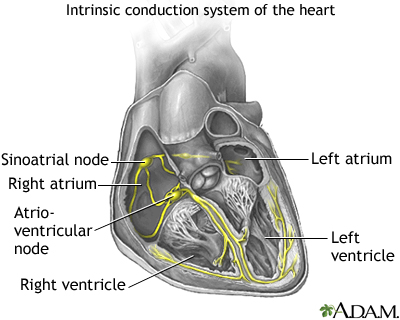
Electrical signals direct your heart to pump the right amount of blood for your body’s needs. The signals begin in an area called the sinoatrial node (also called the sinus node or SA node).
In people with AFib, the electrical impulse of the heart is not regular. This is because the sinoatrial node no longer controls the sequence of heart muscle contractions (rhythm) in the upper chambers of the heart (atria).
In AFib:
The atria do not contract in an organized pattern.
The lower chambers of the heart (ventricles) contract in an irregular manner that is often too fast.
As a result, the heart often cannot pump enough blood to meet the body’s needs.
In people with atrial flutter, the atria beat very rapidly, but in a regular pattern.
These problems can affect both men and women. They become more common with increasing age.
Chest pain or pressure, which may be a sign of a heart attack. Call 911 or the local emergency number right away if you have chest pain or pressure.
Exams and Tests
Your health care provider may hear a fast heartbeat while listening to your heart with a stethoscope. Your pulse may feel fast, uneven, or both.
The normal heart rate is 60 to 100 beats per minute. In Afib or flutter, the heart rate may be as high as 250 to 350 beats per minute and is very often over 100 beats per minute. Blood pressure may be normal or low.
An ECG (a test that records the electrical activity of the heart) may show AFib or atrial flutter.
If your abnormal heart rhythm comes and goes, you may need to wear a special monitor to diagnose the problem. The monitor records the heart’s rhythms over a period of time.
Cardioversion treatment may be used to get the heart back into a normal rhythm right away. There are two options for treatment:
Electric shocks to your heart
Medicines given through a vein
These treatments may be done as emergency methods, or planned ahead of time.
Daily medicines taken by mouth are used to:
Slow the irregular heartbeat and maintain normal heart rhythm — These medicines may include beta-blockers, calcium channel blockers, digoxin, and anti-arrhythmics.
Prevent blood clots — Blood-thinning medicines are often given to reduce the risk of blood clots that can result from ongoing irregular heart rhythms.
Prevent AFib from coming back — These medicines work well in many people, but they can have serious side effects. AFib returns in many people, even while they are taking these medicines.
A procedure called radiofrequency ablation can be used to scar areas in your heart where the heart rhythm problems are triggered. This can prevent the abnormal electrical signals that cause AFib or flutter from moving through your heart. You may need a heart pacemaker after this procedure. All people with AFib will need to learn how to manage this condition at home.
People with AFib will most often need to take blood thinner medicines. These medicines are used to reduce the risk of developing a blood clot that travels in the body (and that can cause a stroke, for example). The irregular heart rhythm that occurs with AFib makes blood clots more likely to form.
Blood thinner medicines include heparin, warfarin (Coumadin), apixaban (Eliquis), rivaroxaban (Xarelto), edoxaban (Savaysa) and dabigatran (Pradaxa). Antiplatelet medicines such as aspirin or clopidogrel may also be prescribed. However, blood thinners increase the chance of bleeding, so not everyone can use them.
Another stroke prevention option for people who cannot safely take these medicines are left atrial appendage occlude (LAAO) devices. These are small implants that are placed inside the heart to block off the area of the heart where most of the clots form. This limits clots from forming.
Your provider will consider your age and other medical problems when deciding which stroke prevention methods are best for you.
Outlook (Prognosis)
Treatment can often control this disorder. Many people with AFib do very well with treatment.
AFib tends to return and get worse. It may come back in some people, even with treatment.
Clots that break off and travel to the brain can cause a stroke.
When to Contact a Medical Professional
Contact your provider if you have symptoms of AFib or flutter.
Prevention
Talk to your provider about steps to treat conditions that cause atrial fibrillation and flutter. Avoid binge drinking.
Calkins H, Tomaselli GF, Morady F. Atrial fibrillation: clinical features, mechanisms, and management. In: Libby P, Bonow RO, Mann DL, Tomaselli GF, Bhatt DL, Solomon SD, eds. Braunwald’s Heart Disease: A Textbook of Cardiovascular Medicine. 12th ed. Philadelphia, PA: Elsevier; 2022:chap 66.
Joglar JA, Chung MK, Armbruster AL, et al. 2023 ACC/AHA/ACCP/HRS Guideline for the diagnosis and management of atrial fibrillation: A Report of the American College of Cardiology/American Heart Association Joint Committee on Clinical Practice Guidelines. Circulation. 2024;149(1):e1-e156. PMID: 38033089 pubmed.ncbi.nlm.nih.gov/38033089/.
Zimetbaum P, Goldman L. Supraventricular ectopy and tachyarrhythmias. In: Goldman L, Cooney KA, eds. Goldman-Cecil Medicine. 27th ed. Philadelphia, PA: Elsevier; 2024:chap 52.
Review Date 1/1/2025
Updated by: Michael A. Chen, MD, PhD, Associate Professor of Medicine, Division of Cardiology, Harborview Medical Center, University of Washington Medical School, Seattle, WA. Also reviewed by David C. Dugdale, MD, Medical Director, Brenda Conaway, Editorial Director, and the A.D.A.M. Editorial team.
 Crystal's Coder Hub