 Crystal's Coder Hub
🧬 ICD-10-CM G05.3 — Encephalitis and Encephalomyelitis in Diseases Classified Elsewhere
Billable Code Confirmed
ICD-10-CM G05.3 is a valid, billable 4-character diagnosis code. The first three characters (G05) define the category of encephalitis, myelitis, and encephalomyelitis in diseases classified elsewhere. The 4th character (3) specifies encephalitis and encephalomyelitis (excluding isolated myelitis). No additional characters are required.
Non-Billable Parent Codes — Never Submit These
- ❌
G05— 3-character header — Lacks specificity regarding whether the condition is encephalitis or myelitis.Always submit G05.3 (all 4 characters) when secondary encephalitis or encephalomyelitis is documented.
Clinical Context: Manifestation Code Rule (Code First)
ICD-10-CM G05.3 is a pure manifestation code. ICD-10-CM guidelines strictly require the use of an underlying disease code first. It is a violation of coding conventions to list G05.3 as the principal or primary diagnosis. You must sequence the systemic disease causing the brain inflammation before G05.3.
Code Classification
ICD-10-CM Diagnosis Code — wRVU, assistant payable, and global period fields are not applicable. See CPT Procedural Crosswalk and ICD-10-PCS Crosswalk sections for associated procedural billing.
🔍 Code Description
ICD-10-CM G05.3 classifies Encephalitis and encephalomyelitis in diseases classified elsewhere.
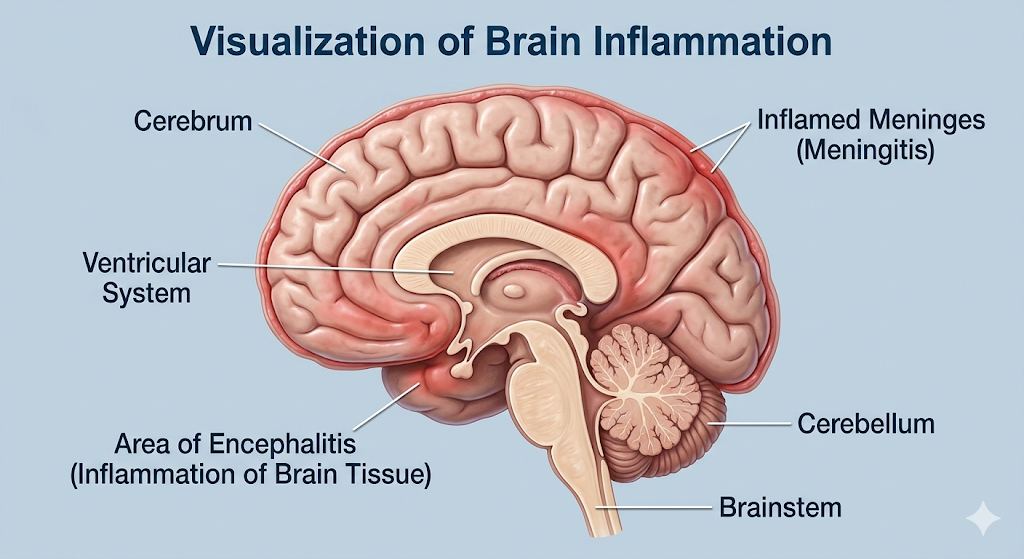
This code represents acute or chronic inflammation of the brain (encephalitis) or brain and spinal cord (encephalomyelitis) that occurs secondarily as a complication of a systemic disease, infection, or autoimmune process coded elsewhere in the ICD-10-CM manual.
Clinically, this diagnosis is given when a patient presents with altered mental status, fever, seizures, or focal neurological deficits, and the workup reveals that the central nervous system inflammation is a direct manifestation of another recognized systemic disease (such as Lupus, HIV, or an explicitly classified parasitic infection).
🌳 Code Tree / Hierarchy
G05 Encephalitis, myelitis and encephalomyelitis in diseases classified elsewhere ❌ Non-billable
│
├── G05.3 Encephalitis and encephalomyelitis in diseases classified elsewhere ◀ THIS CODE ✅ Billable
└── G05.4 Myelitis in diseases classified elsewhere ✅ Billable
Specificity
Use G05.3 when the brain is involved (encephalitis/meningoencephalitis). If the inflammation is strictly isolated to the spinal cord without brain involvement, use the sibling code
G05.4instead.
✅ Includes
The following clinical terms and scenarios map to G05.3 when documented alongside an underlying condition:
- Secondary encephalitis
- Meningoencephalitis in diseases classified elsewhere
- Encephalomyelitis secondary to a systemic disorder
📋 Clinical Overview
Required Primary Diagnoses (“Code First” Mandates)
Because G05.3 describes the manifestation, the ICD-10-CM manual provides explicit “Code First” instructions. Common underlying conditions that must be sequenced before G05.3 include, but are not limited to:
| Systemic Disease / Infection | Code First (Primary Diagnosis) | Manifestation (Secondary Diagnosis) |
|---|---|---|
| Systemic Lupus Erythematosus (SLE) | M32.19 (Other organ/system involvement in SLE) | G05.3 |
| HIV Disease | B20 (Human immunodeficiency virus disease) | G05.3 |
| Congenital Toxoplasmosis | P37.1 (Congenital toxoplasmosis) | G05.3 |
| Cytomegaloviral Disease | B25.8 (Other cytomegaloviral diseases) | G05.3 |
| Eosinophilic Meningoencephalitis | B83.2 (Angiostrongyliasis) | G05.3 |
| Trichinellosis | B75 (Trichinellosis) | G05.3 |
Manifestation Sequencing Rule
If a claim is submitted with G05.3 in the first position, it will be rejected immediately by the payer’s clearinghouse for failing the “Manifestation Code as Principal Diagnosis” edit.
💰 HCC Risk Adjustment (CMS-HCC v28)
| Field | Detail |
|---|---|
| CMS-HCC Model Version | v28 (2024-2025 Implementation) |
| HCC Assignment | ✅ Mapped — HCC 76 |
| HCC Category | HCC 76 (Neurological Conditions) |
G05.3 maps to HCC 76, reflecting severe neurological involvement. More importantly, capturing this code accurately also demands capturing the primary etiology code (like HIV or SLE), which typically compounds the total patient Risk Adjustment Factor (RAF) score due to multi-system complexity.
🏥 DRG Assignment
MDC 01 — Diseases and Disorders of the Nervous System
Note: While G05.3 cannot be a principal diagnosis, if the principal diagnosis falls into MDC 01 (e.g., an unclassified neurological disorder acting as a placeholder), the presence of G05.3 behaves as a CC (Complication/Comorbidity).
| DRG | Title |
|---|---|
| DRG 097 | Non-Bacterial Infections of Nervous System Except Viral Meningitis with MCC |
| DRG 098 | Non-Bacterial Infections of Nervous System Except Viral Meningitis with CC |
| DRG 099 | Non-Bacterial Infections of Nervous System Except Viral Meningitis without CC/MCC |
DRG Optimization
If a patient with Systemic Lupus Erythematosus (M32.19) is admitted for lupus encephalitis, M32.19 is the principal diagnosis (grouping to MDC 08). Adding G05.3 acts as a powerful secondary CC, ensuring the severity of the patient’s presentation is accurately reflected in the final DRG weight.
🛠️ Commonly Associated CPT Codes (Neurology / Inpatient)
| CPT Code | Description | Profee Coding Notes (Modifier 26) |
|---|---|---|
| 62270 | Spinal puncture, lumbar, diagnostic | Used to obtain CSF to confirm secondary encephalitis and rule out primary bacterial/viral causes. |
| 70551 | Magnetic resonance (e.g., proton) imaging, brain (without contrast) | Modifier -26 required for professional interpretation if the scan is performed in a facility setting.^6 |
| 99222 | Initial hospital inpatient or observation care, per day (Moderate MDM) | Requires Modifier -25 if a diagnostic procedure (like lumbar puncture) is billed by the same provider on the same day. |
💊 Coding Scenarios and Examples
Scenario 1 — Inpatient: Lupus Encephalitis
Clinical Vignette: A 35-year-old female with a known history of Systemic Lupus Erythematosus (SLE) presents to the ED with severe confusion, lethargy, and a new-onset seizure. MRI brain shows changes consistent with cerebritis. Lumbar puncture is negative for primary infection. The rheumatologist and neurologist confirm a diagnosis of lupus encephalitis and start high-dose IV corticosteroids.
Principal Diagnosis:
- M32.19 — Other organ or system involvement in systemic lupus erythematosus (Reason for admission/Underlying etiology)
Secondary Diagnoses:
- G05.3 — Encephalitis and encephalomyelitis in diseases classified elsewhere (Manifestation)
- R56.9 — Unspecified convulsions (Symptom treated during admission)
Scenario 2 — CDI Query: Missing Underlying Cause
Clinical Vignette: A patient with advanced HIV is admitted. The neurologist documents: “Patient has HIV. Currently experiencing meningoencephalitis.” The coder is unsure if the provider is linking the HIV to the encephalitis.
Action / Outcome: Do not assume the causal link between HIV and meningoencephalitis unless explicitly stated or unless the index directs it by default. Send a CDI query to the provider asking to clarify the etiology of the meningoencephalitis (e.g., “Is the meningoencephalitis due to the HIV, a separate opportunistic infection like Cryptococcus, or undetermined?”).
Query Response: Provider updates: “Meningoencephalitis secondary to HIV disease.”
Corrected ICD-10-CM Coding:
- B20 — Human immunodeficiency virus [HIV] disease (Sequence first)
- G05.3 — Encephalitis and encephalomyelitis in diseases classified elsewhere (Sequence second)
⚠️ Coding Pitfalls and Tips
| Pitfall or Tip | |
|---|---|
| ❌ | Sequencing Error. Never sequence G05.3 as the primary or first-listed diagnosis on a claim. Doing so violates the ICD-10-CM “Code First” convention for manifestation codes. |
| ❌ | Using G05.3 for Primary Infections. Do not use G05.3 for primary viral encephalitis (e.g., Herpes Simplex encephalitis). Primary CNS infections have their own specific combination codes (e.g., B00.4 for Herpesviral encephalitis). |
| ✅ | Query for Linkage. If a patient has a systemic disease capable of causing encephalitis (like SLE or HIV) but the provider has not explicitly linked the two in their documentation, query the provider. |
| ✅ | Capture Additional Manifestations. A patient may have multiple manifestations of an underlying disease. Code all documented manifestations (e.g., coding both lupus nephritis and lupus encephalitis) to maximize specificity and capture full HCC risk. |
📚 Sources
1. CMS/NCHS. ICD-10-CM Official Guidelines for Coding and Reporting, FY2025. (Guideline I.B.7 — Multiple coding for single conditions: Etiology/manifestation convention).2. American Academy of Neurology (AAN). Clinical consensus on the management of autoimmune and secondary encephalitis.
3. Ellul M., et al. (2020). Neurological associations of systemic disease. Lancet Neurology, 19(9), 767-783. (Source for clinical context of secondary encephalitis).
4. CMS. 2025 Medicare Advantage Risk Adjustment — CMS-HCC Model v28 ICD-10-CM Mappings.
5. CMS. IPPS Final Rule FY2025 — MS-DRG Definitions Manual v42.
6. AMA. CPT Professional Edition 2025. Radiology & Surgery guidelines.