E/M Coding: Office & Other Outpatient Services (99202–99215)
📋 Regulatory Foundations (CMS, AMA CPT, AAPC & AHIMA)
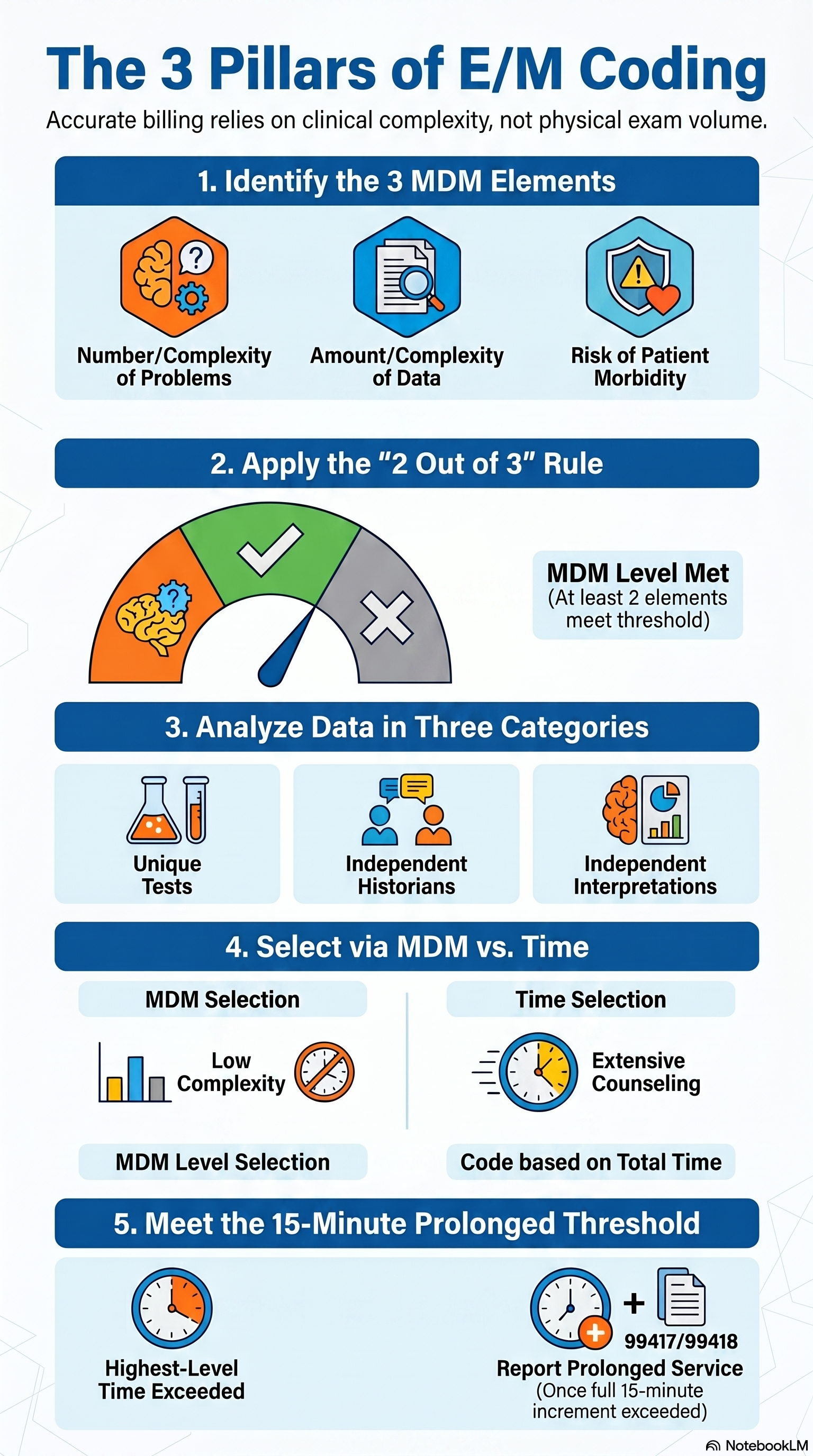
Office and other outpatient Evaluation and Management (E/M) services (99202–99205 and 99211–99215) are governed by the joint AMA/CMS E/M guidelines. Code selection is determined exclusively by Medical Decision Making (MDM) OR Total Time spent on the calendar date of the encounter.
Key Regulatory Rule: While a medically appropriate history and physical examination must be documented, history and physical exam do not determine the level of E/M code. The nature and extent of history and physical exam are at the clinical discretion of the treating physician or Qualified Healthcare Professional (QHP).
Patient Status Definitions
- New Patient: An individual who has not received any professional services (face-to-face or E/M) from the physician/QHP or another physician/QHP of the exact same specialty and subspecialty who belongs to the same group practice (identified by the same Tax ID Number / TIN) within the previous 3 years (36 months).
- Established Patient: An individual who has received professional services from the physician/QHP or another physician/QHP of the same specialty/subspecialty in the same group practice within the previous 3 years.
- Specialty Taxonomy Note: Under CMS and commercial payer audit rules, subspecialty designations are recognized via official Medicare taxonomy codes. When a physician is covering for another physician, the patient’s status is categorized exactly as it would be for the physician being covered.
⏱️ Selection by Total Time (2026 Guidelines)
Under the revised CPT time guidelines maintained for 2026, code selection based on time requires that the minimum time threshold must be met or exceeded. Time ranges have been replaced with minimum thresholds.
2026 Outpatient E/M Time Thresholds
- New Patients:
- Established Patients:
Activities Qualifying Toward Total Practitioner Time
Time counted is the cumulative face-to-face and non-face-to-face time personally spent by the billing physician/QHP on the calendar date of the encounter:
- Preparing to see the patient (e.g., review of external tests, previous clinical notes).
- Obtaining and/or reviewing separately obtained history.
- Performing a medically appropriate examination and/or evaluation.
- Counseling and educating the patient, family, or caregiver.
- Ordering medications, diagnostic tests, or clinical procedures.
- Referring and communicating with other healthcare professionals (when not reported separately).
- Documenting clinical information in the electronic health record (EHR).
- Independently interpreting diagnostic results (when not reported separately under a CPT procedure code) and communicating results to the patient/family.
- Care coordination (when not reported separately).
Non-Qualifying Activities (Audit Exclusions)
- Clinical Staff Time: Travel time, vitals collection, rooming, or intake time performed by nurses or medical assistants cannot be counted toward physician/QHP time.
- Separately Reportable Services: Any time spent performing procedures or diagnostic tests that are reported separately (e.g., 93000 for EKG interpretation, minor office excisions, joint injections) must be carved out of the total E/M time.
- Time on Different Dates: Work performed on the day before or day after the visit cannot be counted toward same-day outpatient E/M time.
- General Teaching/Travel: Time spent teaching students or resident general rounds without direct patient involvement, as well as travel time, is strictly non-billable.
⌛ Prolonged Services: CPT vs. CMS (Medicare) Discrepancy
When total time exceeds the highest level code (99205 or 99215), prolonged service codes may be added. CMS and CPT maintain different threshold standards:
| Code Level | Service Type | CPT Standard Code: 99417 (Commercial / Non-Medicare) | CMS Standard Code: G2212 (Medicare / Medicare Advantage) |
|---|---|---|---|
| New Pt (99205) | Base Code Threshold | 60 minutes | 60 minutes |
| New Pt + 1 Unit | 1st 15-min Increment | 75–89 minutes (15 min beyond 60 min) | 89–103 minutes (15 min beyond 74 min theoretical max) |
| New Pt + 2 Units | 2nd 15-min Increment | 90–104 minutes | 104–118 minutes |
| Est Pt (99215) | Base Code Threshold | 40 minutes | 40 minutes |
| Est Pt + 1 Unit | 1st 15-min Increment | 55–69 minutes (15 min beyond 40 min) | 69–83 minutes (15 min beyond 54 min theoretical max) |
| Est Pt + 2 Units | 2nd 15-min Increment | 70–84 minutes | 84–98 minutes |
Audit Caution: Reporting 99417 on a Medicare claim results in an automated claim denial. Always report HCPCS code G2212 for Medicare fee-for-service and payers adhering to CMS guidelines.
⚡ Medical Decision Making (MDM) Framework
To select a level of E/M based on MDM, 2 of the 3 elements must be met or exceeded:
- Number and Complexity of Problems Addressed
- Amount and/or Complexity of Data to be Reviewed and Analyzed
- Risk of Complications and/or Morbidity or Mortality of Patient Management
2026 MDM Scoring Matrix
| MDM Level | Matching CPT Codes | Number & Complexity of Problems | Amount & Complexity of Data (Must meet 1 category for Mod; 2 for High) | Risk of Patient Management |
|---|---|---|---|---|
| Straightforward | 99202 99212 | Minimal: • 1 self-limited or minor problem | Minimal or None | Minimal risk: • Rest, gargling, ice pack, OTC dressings |
| Low | 99203 99213 | Low: • 2+ self-limited or minor problems; OR • 1 stable chronic illness; OR • 1 acute, uncomplicated illness or injury; OR • 1 stable, acute illness; OR • 1 acute, uncomplicated illness/injury requiring hospital IP or observation | Limited (Must meet at least 1 of 2 categories): • Category 1 (Tests/Docs): Any combination of 2 from: review of prior external notes, order of unique test, review of unique test result; OR • Category 2: Assessment requiring an independent historian | Low risk: • Over-the-counter (OTC) medications • Physical therapy / Occupational therapy • Minor surgery without identified risk factors |
| Moderate | 99204 99214 | Moderate: • 1+ chronic illnesses with mild exacerbation, progression, or treatment side effects; OR • 2+ stable chronic illnesses; OR • 1 undiagnosed new problem with uncertain prognosis; OR • 1 acute illness with systemic symptoms; OR • 1 acute complicated injury | Moderate (Must meet at least 1 of 3 categories): • Category 1 (Tests/Docs/Historian): Any combination of 3 from: review of prior external notes, order of unique test, review of unique test result, independent historian; OR • Category 2: Independent interpretation of tests performed by another provider (not separately billed); OR • Category 3: Discussion of management or test interpretation with external physician/QHP | Moderate risk: • Prescription drug management • Decision regarding minor surgery with identified patient or procedure risk factors • Decision regarding elective major surgery without identified risk factors • Diagnosis or treatment significantly limited by Social Determinants of Health (SDOH) |
| High | 99205 99215 | High: • 1+ chronic illnesses with severe exacerbation, progression, or treatment side effects; OR • 1 acute or chronic illness or injury that poses a threat to life or bodily function | Extensive (Must meet at least 2 of 3 categories): • Category 1: Any combination of 3 items (review external notes, order tests, review test results, independent historian); • Category 2: Independent interpretation of tests not separately billed; • Category 3: Discussion of management/test interpretation with external provider | High risk: • Drug therapy requiring intensive monitoring for toxicity • Decision regarding elective major surgery with identified patient/procedure risk factors • Decision regarding emergency major surgery • Decision regarding hospitalization or escalation of hospital-level care • Decision not to resuscitate or de-escalate care due to poor prognosis • Parenteral controlled substances |
🔍 Deep-Dive MDM Component Nuances
1. Problem Complexity Definitions
- Stable Chronic Illness: A problem with an expected duration of at least 1 year or until the death of the patient. The patient’s condition is at baseline or target treatment control (e.g., well-managed hypertension, controlled E11.9 type 2 diabetes).
- Chronic Illness with Mild Exacerbation/Progression: Not at treatment goal, experiencing a mild flare-up or progression requiring medication titration or treatment adjustment.
- Undiagnosed New Problem with Uncertain Prognosis: A diagnostic dilemma where differential diagnoses carry potential for significant morbidity if untreated (e.g., new lump in breast, acute undiagnosed chest discomfort).
- Acute Illness with Systemic Symptoms: An illness causing significant general symptoms affecting whole body systems (e.g., high fever, pyelonephritis, pneumonia, acute influenza with dehydration).
- Threat to Life or Bodily Function: Severe acute or chronic decompensation carrying imminent risk of organ damage or mortality (e.g., unstable angina, acute pulmonary embolism, acute renal failure, severe ketoacidosis).
2. Data Categories & Scoring Rules
- Unique Test: Each distinct CPT code is counted as one unique test. An entire panel (e.g., 80053 Comprehensive Metabolic Panel) counts as one test, not multiple tests for each individual analyte.
- Ordering vs. Reviewing: Ordering a test includes the subsequent review of that test. You cannot count an order and a review for the same test in the same or future encounter. If a provider orders a test, they get credit for the order; they cannot claim credit for reviewing it when the result arrives later.
- Independent Interpretation: The physician must independently interpret a diagnostic test that was performed by another provider and has an official CPT code with both technical and professional components (e.g., X-ray, EKG, echocardiogram). The provider must document a written interpretation in the chart and must not bill the professional component of that CPT code.
- Discussion with External Provider: Must be an interactive discussion (phone, video, direct conversation, or secure direct messaging) with a physician/QHP from an outside practice, facility, or different specialty. Internal discussions between providers of the same subspecialty in the same group cannot be scored.
3. Risk of Patient Management Nuances
- Prescription Drug Management:
- Must be documented as an active clinical decision: starting a new medication, modifying dosage, discontinuing therapy, or actively evaluating and deciding to continue current dosage with explicit clinical rationale.
- Audit Vulnerability: Simply listing current medications in the chart or reconciling a list without clinical discussion does not qualify as prescription drug management.
- Intensive Drug Monitoring for Toxicity:
- Requires monitoring of therapeutic drug levels or target organ toxicity (e.g., regular monitoring of CBC for antineoplastic agents, renal function for nephrotoxic agents, therapeutic drug levels for lithium, warfarin INR, amiodarone organ toxicity).
- Monitoring must be performed via laboratory, diagnostic, or clinical evaluations occurring at least quarterly.
- Routine monitoring for therapeutic efficacy (e.g., annual lipid panel for statins, periodic HbA1c for metformin) does not qualify as monitoring for toxicity.
- Social Determinants of Health (SDOH):
- Qualifying conditions include economic instability, housing insecurity, food insecurity, or lack of transportation that directly and significantly impairs the patient’s diagnostic evaluation or treatment adherence.
- Clinician must document how the specific social barrier influenced patient management.
🏷️ CMS Add-on Code: G2211 (Visit Complexity Inherent to Longitudinal Care)
HCPCS code G2211 is an add-on code intended to reimburse the cognitive and care coordination investment inherent in longitudinal patient relationships.
Billing Criteria
- Primary Care Focal Point: The provider serves as the continuing focal point for all needed healthcare services (comprehensive primary care over time).
- Specialized Longitudinal Care: The provider is treating a single, continuous, serious condition or a complex condition (e.g., oncology, rheumatology, endocrinology) over an extended duration.
- Eligible Base Codes: Office and outpatient E/M codes 99202–99205 and 99211–99215.
Crucial CMS Modifier -25 Restriction
- CMS Policy: CMS prohibits billing G2211 when the associated E/M service is billed with Modifier -25 for a minor procedure performed on the same date (e.g., minor skin excision, joint injection, cryotherapy).
- Exception: In 2025/2026, CMS finalized exceptions allowing G2211 when the visit is billed with modifier -25 solely in conjunction with an annual wellness visit (AWV), vaccine administration, or certain non-surgical preventive services.
⚠️ Modifier Compliance & Audit Traps
1. Modifier -25 (Significant, Separately Identifiable E/M)
- The Rule: An E/M service performed on the same calendar date as a minor surgical procedure (0-day or 10-day global period) must be significant, separately identifiable, and above and beyond the typical pre-procedure and post-procedure care inherent in the procedure.
- The “Pre-op Exam” Trap: Every minor surgical procedure includes inherent pre-operative evaluation, obtaining informed consent, and post-procedure patient instructions. A separate E/M cannot be billed if the work is solely related to evaluating the need for or performing the minor procedure.
- Stand-Alone Documentation Standard: If all documentation related to the procedure is redacted from the medical record, the remaining documentation must independently support the billed level of E/M.
2. Modifier -24 (Unrelated E/M During a Global Post-operative Period)
- Appended to an E/M service performed during the 10-day or 90-day global period of a surgical procedure when the visit is for a completely unrelated clinical problem (e.g., evaluation of acute sinusitis during the 90-day post-op period of a cataract extraction).
- The diagnosis codes must clearly substantiate the unrelated condition.
3. Modifier -57 (Decision for Major Surgery)
- Appended to an E/M service performed on the day of or the day immediately prior to a major surgical procedure (90-day global period) that resulted in the initial decision to perform the surgery.
- Do NOT use -57 for minor procedures (0 or 10-day global); use -25 if criteria are met.
4. Direct Supervision & 99211 (“Nurse Visit”)
- 99211 represents an E/M service provided by clinical staff (e.g., RN, LPN, CMA) under the direct supervision of a physician or QHP.
- Under CMS Incident-To rules in an office setting (POS 11), a supervising physician or QHP must be physically present in the office suite and immediately available to provide assistance.
- Does not require physician face-to-face contact.
- Cannot be reported for new patients or for services that represent routine administrative tasks (e.g., handing a patient a pre-written prescription).
🚨 CDI & Audit Checklists / Query Triggers
High-Risk Audit Triggers
- Billing 99214 / 99215 Solely by Time Without Start/Stop or Total Minutes: A note stating “spent extended time with patient” will be downcoded on audit to 99212 or denied. The note must document exact total minutes spent on the calendar date (e.g., “Total time personally spent on date of encounter: 36 minutes”).
- Double-Dipping on Diagnostic Tests: Crediting both an “order” and a “review” for the same laboratory or radiological test in the Data column.
- Unsubstantiated Rx Management: Listing medications on a home medication list without documenting physician clinical action (initiated, discontinued, titrated, or maintained with risk assessment).
- Billing G2211 with Surgical Modifier -25: Automated edit triggers claim denial if G2211 is paired with an E/M carrying modifier -25 alongside a minor procedural CPT.
- Independent Interpretation Without Report: Counting Category 2 Data without a distinct, written interpretation in the chart or when the provider simultaneously bills the professional component of the imaging/tracing code.
📂 Clinical Case Scenarios
Case 1: Established Patient — Moderate MDM (99214 + G2211)
- Subjective: 62-year-old established male presents for routine follow-up of type 2 diabetes mellitus and primary hypertension. Reports mild bilateral lower extremity edema.
- Objective: BP 148/92, HbA1c 8.4% (elevated from 7.2%). Exam shows 1+ pretibial edema.
- Assessment & Plan:
- Type 2 Diabetes: Uncontrolled. Metformin increased from 500 mg BID to 1000 mg BID. Ordered comprehensive metabolic panel and urine microalbumin.
- Hypertension: Inadequate control. Lisinopril continued at 20 mg daily; added hydrochlorothiazide 12.5 mg daily.
- MDM Analysis:
- Problems: 1 chronic illness with mild exacerbation (diabetes) + 1 stable chronic illness (hypertension) = Moderate.
- Data: Category 1: Ordered 2 unique tests (CMP, urine microalbumin) = Limited.
- Risk: Prescription drug management (titrated Metformin, initiated HCTZ) = Moderate.
- Outcome: 2 of 3 met at Moderate level = 99214.
- Longitudinal Care: Provider is patient’s primary care focal point = Bill 99214 and G2211.
Case 2: Established Patient — Minor Procedure with Modifier -25
- Clinical Presentation: 45-year-old female presents for scheduled excision of a biopsy-proven benign skin lesion on the back. During the encounter, she complains of acute right wrist pain following a fall yesterday, with localized swelling.
- Management:
- Physician performs clinical exam of wrist, orders and independently reviews 3-view wrist X-ray (negative for fracture), diagnoses acute wrist sprain, provides wrist splint, and counsels on rest and ice.
- Physician then separately preps, drapes, and performs excisional removal of the 1.5 cm back lesion under local anesthesia.
- Billing Formulation:
Case 3: Established Patient — Time-Based with Prolonged Service (99215 + G2212)
- Clinical Presentation: 78-year-old established female with severe multi-infarct dementia, advanced Parkinson’s disease, and recurring aspiration pneumonia presents with family. Extensive discussion regarding worsening dysphagia, frequent choking episodes, recurrent falls, and caregiver burnout.
- Documentation:
- Physician personally spends 72 minutes of cumulative time on the calendar date of the encounter: 15 minutes reviewing home health reports and neurology records prior to visit, 45 minutes face-to-face counseling patient and family on palliative care transition and advance care planning, and 12 minutes coordinating hospice evaluation and documenting the extensive plan in the EHR.
- Billing Formulation (Medicare Encounter):