Fractures — PM&R Clinical Coding & Reimbursement Reference
Executive Summary & Clinical Foundations
A fracture represents a structural disruption or break in the continuity of bone or cartilage. In medical coding and clinical documentation across Physical Medicine and Rehabilitation (PM&R), acute trauma, and orthopedics, fractures are classified fundamentally by their underlying etiology:
- Traumatic Fractures (ICD-10-CM Chapter 19: S02, S12, S22, S32, S42, S52, S62, S72, S82, S92): Resulting from direct impact, torsional/rotational force, shear, or high-energy mechanical stress exceeding the physiological tensile strength of healthy bone.
- Pathological Fractures (ICD-10-CM Chapter 13: M84.4x, M84.5x, M84.6x): Occurring spontaneously or secondary to trivial trauma in bone structurally compromised by disease processes (e.g., primary or metastatic neoplasm, osteomyelitis, Paget’s disease, or hyperparathyroidism).
- Osteoporotic Fractures (ICD-10-CM Chapter 13: M80): Fragility fractures occurring in osteopenic/osteoporotic bone under minimal or low-energy forces (e.g., fall from standing height).
- Stress Fractures (ICD-10-CM Chapter 13: M84.3): Microfractures resulting from abnormal, cumulative, repetitive mechanical loading on normal bone (fatigue fractures) or normal load on deficient bone (insufficiency fractures).
- Periprosthetic Fractures (ICD-10-CM Chapter 19: M97): Fractures occurring around an implanted endoprosthesis or internal fixation construct.
In PM&R and post-acute care, accurate fracture reporting demands granular identification of:
- Anatomical site and laterality (e.g., proximal, shaft, distal, intra-articular; right, left).
- Displacement status (displaced vs. nondisplaced).
- Integumentary integrity (open vs. closed).
- Open fracture Gustilo-Anderson classification (Grades I, II, IIIA, IIIB, IIIC).
- Salter-Harris physeal involvement (pediatric growth plate injuries, Types I–V).
- Episode of care / 7th-character healing status (active treatment vs. routine healing, delayed healing, nonunion, malunion, or sequela).
Fracture Classification & Morphology
Closed vs. Open Fractures
- Closed Fracture: The cutaneous barrier remains intact; the fractured bone fragments do not communicate with the external environment.
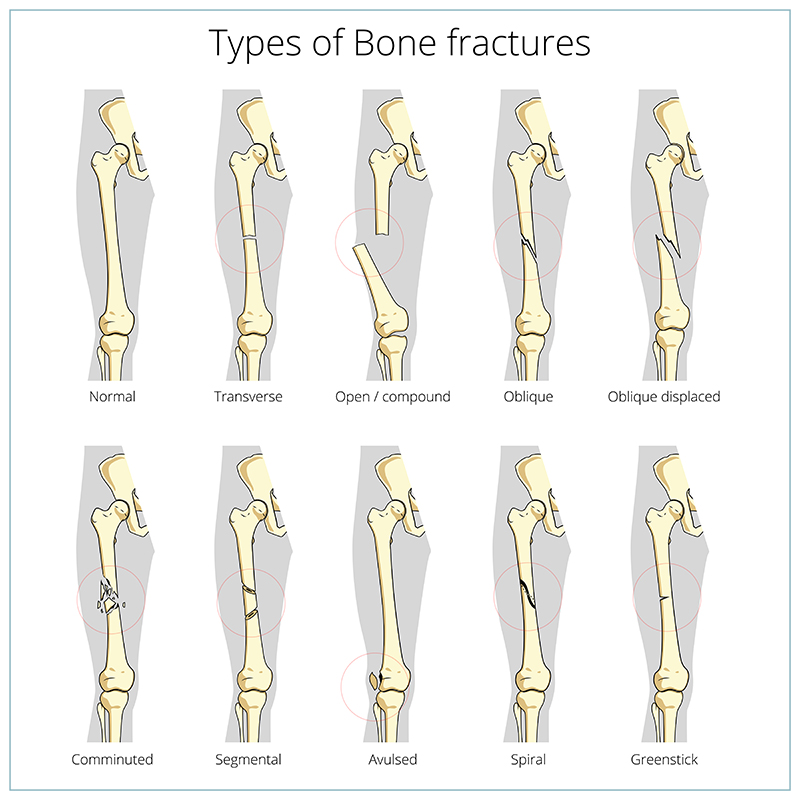
- Open (Compound) Fracture: Associated with an open dermal wound leading directly to the fracture hematoma or broken bone ends piercing through adjacent soft tissues and skin. Open fractures carry severe risks of osteomyelitis, soft-tissue necrosis, compartment syndrome, and systemic sepsis.
Specific Morphological Terminology
- Comminuted: The bone is shattered, splintered, or crushed into three or more fragments, typically indicating high-energy trauma.
- Impacted: Bone fragments are forcibly driven or wedged into one another by axial loading.
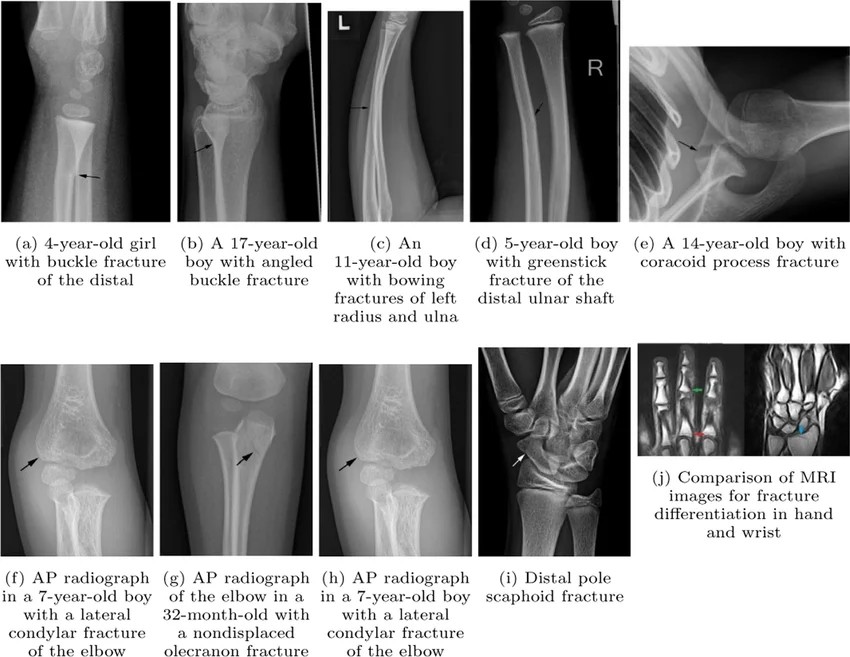
- Greenstick: An incomplete pediatric fracture in which the convex cortex breaks while the concave cortex bends; characteristic of pliable, growing bone.
- Torus (Buckle): An incomplete pediatric impaction fracture where the bone cortex buckles or wrinkles under longitudinal compressive forces without a true fracture line.
- Oblique: A fracture plane oriented obliquely/diagonally (at an angle other than 90 degrees) across the long axis of the bone.
- Transverse: A fracture line that runs perpendicular (at a right angle) to the long axis of the bone, commonly caused by direct perpendicular bending forces.
- Spiral (Torsion): Produced by torsional or twisting forces along the bone shaft, creating a helical or spiral fracture trajectory; common in sports injuries and non-accidental trauma.
- Segmental: A severe multi-level fracture where two distinct fracture lines isolate a central, free-floating intermediate bone segment completely separated from the proximal and distal shafts.
- Avulsion: A fracture where a bone fragment is forcibly pulled away from its main body by the sudden, violent traction of an attached tendon, ligament, or joint capsule.
- Depression: A fracture in which a fragment of bone is depressed below the normal surface (predominantly seen in skull fractures or tibial plateau fractures).
- Physeal (Salter-Harris): Pediatric fractures involving the cartilaginous growth plate (physis).
Gustilo-Anderson Classification System (Open Fractures)
Under official CMS, AHA Coding Clinic, and AAPC/AHIMA guidelines, the classification of traumatic open fractures of the extremities relies on the Gustilo-Anderson system. This system dictates both the ICD-10-CM 7th-character selection and clinical risk stratification:
| Gustilo Type | Wound Size / Description | Energy & Contamination | Soft Tissue Injury & Bone Coverage | Vascular Status |
|---|---|---|---|---|
| Type I | Clean skin wound | Low-energy mechanism | Minimal soft-tissue contusion; simple fracture pattern (transverse or short oblique); clean wound bed. | Normal peripheral pulses |
| Type II | Laceration without extensive soft tissue damage | Moderate-energy trauma | Mild to moderate muscle contusion; no periosteal stripping; moderate comminution. | Intact neurovascular exam |
| Type III | Wound , typically wide, ragged, and extensive | High-energy mechanism (e.g., motor vehicle crash, gunshot, crush, farm injury) | Severe soft-tissue destruction, significant devitalization, high contamination, marked comminution/instability. | Subdivided into IIIA, IIIB, IIIC |
| Type IIIA | Extensive soft tissue laceration/flaps, | High-energy | Adequate soft-tissue coverage of the bone despite extensive soft tissue laceration/damage; periosteal stripping is limited. | Normal perfusion |
| Type IIIB | Extensive soft tissue loss with periosteal stripping | Severe contamination (soil, farm machinery) | Inadequate local soft-tissue coverage; bone exposure; requires plastic reconstruction (local or free tissue transfer/flap). | Severe stripping; pulses intact |
| Type IIIC | Open fracture of any dimension with arterial injury | High-energy / life-or-limb threatening | Requires immediate vascular reconstruction/arterial repair for limb salvage, irrespective of soft-tissue damage. | Compromised/repaired arterial supply |
Pediatric Physeal Fractures: Salter-Harris Classification
Physeal injuries are coded with unique subcategories within the ICD-10-CM trauma chapters (e.g., S89.0–S89.3 for distal femur/tibia):
- Type I: Transverse fracture straight across the physis (growth plate) with complete separation of the epiphysis from the metaphysis; germinal cells intact.
- Type II: Fracture through the physis extending obliquely into the metaphysis (creating the classic Thurston-Holland sign corner fragment). Most common type.
- Type III: Intra-articular fracture extending through the physis and traversing down through the epiphysis into the joint space.
- Type IV: Intra-articular fracture traversing through the metaphysis, across the physis, and through the epiphysis into the joint. High risk of growth arrest and limb length discrepancy.
- Type V: Severe longitudinal compressive/crush injury to the physis, destroying the germinal layer. Often diagnosed retrospectively upon premature growth plate fusion.
2026 ICD-10-CM Official Guidelines for Fracture Coding
1. Default Coding Guidelines (CMS / CDC / AHA Coding Clinic)
- Displacement Default: When clinical documentation does not specify whether a traumatic fracture is displaced or nondisplaced, the coding professional must code to displaced.
- Open vs. Closed Default: When clinical documentation fails to specify whether a traumatic fracture is open or closed, the fracture must be coded to closed.
- Gustilo Open Default: If an extremity fracture is documented as open without specifying the Gustilo type, the default assignment is Type I or Type II (or unspecified open per tabular instructions for that anatomical site).
2. The 7th-Character Encounter Rule (Section I.C.19.c)
A traumatic fracture code from Chapter 19 is invalid without its mandatory 7th character. The assignment of the 7th character depends strictly on the clinical phase of care, not whether the provider is seeing the patient for the first time:
Initial Encounter (A, B, C): Active Treatment
Used for each encounter where the patient is receiving active treatment for the fracture:
- Surgical management (ORIF, closed reduction, percutaneous pinning, external fixation).
- Emergency department evaluation and acute splint/cast application.
- Initial evaluation and continuing treatment by a new physician (e.g., acute orthopedic specialist consult) while active fracture treatment is underway.
- Note on Open Fractures:
A= Initial encounter for closed fracture.B= Initial encounter for open fracture Type I or II.C= Initial encounter for open fracture Type IIIA, IIIB, or IIIC.
Subsequent Encounter (D, E, F, G, H, J, K, M, N, P, Q, R): Post-Active & Healing Phase
Used for encounters after the patient has completed active treatment and is receiving routine care, monitoring, or rehabilitation during the healing or recovery phase:
- Inpatient rehabilitation facility (IRF) admissions.
- Outpatient physical and occupational therapy (PT/OT).
- Physiatry / PM&R post-acute consultations.
- Routine cast change or removal, brace/splint fitting.
- Removal of external or internal fixation devices.
- Medication adjustments and progress radiographic checks.
Complete 7th-Character Matrix:
| Clinical Healing State | Closed Fracture | Open Fracture (Gustilo I / II) | Open Fracture (Gustilo IIIA / B / C) |
|---|---|---|---|
| Subsequent: Routine Healing | D | E | F |
| Subsequent: Delayed Healing | G | H | J |
| Subsequent: Nonunion | K | M | N |
| Subsequent: Malunion | P | Q | R |
| Sequela (Late Complications) | S | S | S |
| Initial Encounter (Active Treatment) | A | B | C |
The Golden Rule on Aftercare Z-Codes vs. Fractures
NEVER assign an aftercare Z-code (Z47.89, Z48.0, etc.) for the healing or post-acute rehabilitation of a traumatic fracture. Official ICD-10-CM Guideline I.C.19.c explicitly mandates: “The aftercare Z codes should not be used for aftercare for conditions such as injuries or poisonings, where 7th characters are provided to identify subsequent care. Thus, aftercare Z codes should not be used for aftercare of fractures. For aftercare for a traumatic fracture, assign the acute fracture code with the appropriate 7th character (e.g., ‘D’ for routine healing).”
(Note: Aftercare Z-codes like Z47.1 are reserved exclusively for planned follow-up following elective joint replacements, or Z47.81 following surgical amputations).
Complications of Healing:
- Delayed Healing (
G,H,J): The fracture is taking longer to heal than clinically anticipated, but osteogenesis is continuing. - Nonunion (
K,M,N): Permanent failure of healing; pseudoarthrosis formation where fracture fragments fail to unite biologically. - Malunion (
P,Q,R): The fractured bone has healed, but in an abnormal anatomical position (angular, rotational, or shortened deformity). - Sequela (
S): Used when the encounter is for a chronic condition, functional deficit, or residual complication (e.g., post-traumatic osteoarthritis M16.5- / M17.3-, joint contracture M24.5-, or chronic nerve compression) that developed as a late effect after the fracture has healed. Under guideline rules, the residual condition is sequenced first, followed by the fracture code with 7th characterS.
3. Traumatic vs. Pathological vs. Osteoporotic (Fragility) Fractures
- Osteoporotic Fractures (M80): Under Guideline I.C.13.c, if a patient with documented osteoporosis suffers a fracture from minor trauma (e.g., a simple fall from standing height, coughing, or bending over), the condition must be coded to Category M80 (Osteoporosis with current pathological fracture), NOT a traumatic fracture code from Chapter 19. A traumatic code is only reported if the trauma was substantial enough to break healthy, normal bone (e.g., high-speed motor vehicle collision).
- Pathological Fractures Due to Neoplasm (M84.5): When an encounter is for treatment of a pathological fracture caused by a neoplasm:
- If treatment is directed at the fracture, sequence the pathological fracture code first, followed by the code for the neoplasm.
- If treatment is directed solely at the neoplasm, sequence the neoplasm first.
- Stress Fractures (M84.3): Coded from Chapter 13. Requires the 7th character for initial (
A), subsequent (D), or sequela (S). Never report with traumatic injury codes.
4. Multiple Fractures Sequencing Rules
When coding multiple traumatic fractures:
- Sequence by threat to life and clinical severity: pelvis (S32), femur (S72), spine (S12, S22.0, S32.0), and intracranial/facial skull fractures (S02) are prioritized over upper extremity or distal lower extremity fractures.
- In the inpatient setting (MS-DRG assignment), the fracture requiring the greatest consumption of resources and matching the primary reason for admission after study is sequenced as the principal diagnosis.
5. Mandatory External Cause Reporting (ICD-10-CM Chapter 20)
For all initial and subsequent encounters of traumatic fractures, assign external cause codes to provide full epidemiological data:
- Cause / Mechanism: E.g., W01 (fall on same level), V43 (car occupant injured in collision).
- Place of Occurrence: E.g., Y92.019 (private residence).
- Activity: E.g., Y93.01 (walking/running).
- Status: E.g., Y99.8 (civilian activity).
PM&R and Post-Acute Inpatient / Outpatient Guidelines
Inpatient Rehabilitation Facility (IRF) Requirements
In the IRF setting (governed by the CMS Inpatient Rehabilitation Facility Prospective Payment System / IRF-PAI):
- Etiology Diagnosis: When a patient is admitted to an IRF for rehabilitation following fracture management (e.g., status post open reduction internal fixation of a hip or pelvic fracture), the primary diagnosis (Item 22 on IRF-PAI / Principal ICD-10-CM) is the traumatic fracture code with the 7th character
D(subsequent encounter for fracture with routine healing). - Rehabilitation Impairment Categories (RIC):
- RIC 07: Fracture of the Femur (hip fractures, femoral shaft/distal fractures).
- RIC 08: Other Orthopedic (pelvis, spine, upper extremity, tibia/fibula, ankle).
- IMPACT Act Functional Scoring: Documentation must track CMS Section GG self-care and mobility items upon admission and discharge to substantiate medical necessity and payment tiers.
Outpatient PM&R Physiatry & Therapy Billing
- Physiatry E/M Encounters:
- Outpatient new/established visits are reported via 99202–99205 and 99211–99215.
- Inpatient / Observation visits are reported via 99221–99223 (initial), 99231–99233 (subsequent), and 99238–99239 (discharge).
- Physiatrists select E/M level based on Medical Decision Making (MDM) or Total Time spent on the calendar date.
- Global Fracture Care vs. Physiatry Management:
- Orthopedic surgeons often bill global surgical fracture codes (e.g., CPT 27244 for femur ORIF), which carry a 90-day global surgical period.
- If postoperative care is transferred formally from the surgeon to a physiatrist, the surgeon appends Modifier -54 (Surgical care only), and the physiatrist appends Modifier -55 (Postoperative management only).
- If there is no transfer of global surgical care and the physiatrist is managing concurrent medical, functional, and rehabilitation deficits, the physiatrist bills standard E/M codes supported by the fracture diagnosis with 7th character
Dalongside functional deficit codes.
- Therapy Services (PT / OT) Rules:
- Modality and therapeutic procedure codes (e.g., 97110 Therapeutic Exercise, 97112 Neuromuscular Re-education, 97116 Gait Training, 97530 Therapeutic Activities).
- Therapy Modifiers: Mandatory discipline-specific modifiers:
- -GP: Physical therapy services provided under an outpatient PT plan of care.
- -GO: Occupational therapy services provided under an outpatient OT plan of care.
- -CQ: Outpatient physical therapy services delivered in whole or in part by a Physical Therapist Assistant (PTA).
- -CO: Outpatient occupational therapy services delivered in whole or in part by an Occupational Therapy Assistant (OTA).
- CMS 8-Minute Rule: Timed therapy codes require strict calculation of cumulative direct face-to-face treatment minutes according to CMS billing thresholds.
AAPC & AHIMA CDI & Audit Compliance Checklist
| Audit Domain | High-Risk Compliance Failure | Correct Coding Standard & Action |
|---|---|---|
| 7th-Character Selection | Assigning A (initial) in outpatient PM&R or therapy follow-ups. | In PM&R, active surgical/acute stabilization has ended. Assign D (routine healing), G (delayed healing), K (nonunion), or P (malunion). |
| Aftercare Z-Codes | Reporting Z47.89 for traumatic fracture rehabilitation. | Prohibited. Assign the specific Chapter 19 fracture code with subsequent 7th character D. |
| Fragility vs. Trauma | Assigning traumatic S72.- for an 84-year-old with osteoporosis who fell from a chair. | Query provider or code to M80.0- (Age-related osteoporosis with current pathological fracture) per Guideline I.C.13.c. |
| Laterality & Site | Billing unspecified codes ending in .9 or .0. | Audit target. Query clinical chart or operative/radiology reports for left vs. right, exact anatomical third (proximal, shaft, distal). |
| Open Classification | Documenting “open fracture” without Gustilo grade or wound dimensions. | Query surgeon/provider for Gustilo Type (I, II, IIIA, IIIB, IIIC) to establish accurate 7th character (B vs. C, E vs. F, etc.). |
| Functional Links | Billing PM&R therapy without documenting functional loss. | Link fracture diagnosis to functional impairments: M62.81 (muscle weakness), R26.2 (difficulty in walking), M25.6- (stiffness of joint). |
Clinical Coding Scenarios
Scenario 1: Outpatient PM&R Consult for Post-Surgical Hip Fracture
- Clinical Summary: An 80-year-old male presents to the PM&R outpatient clinic 4 weeks post-ORIF for a displaced right femoral neck fracture sustained in an accidental trip and fall on an uneven sidewalk. Active surgical healing is progressing normally. The physiatrist performs an E/M visit focusing on gait dysfunction, quad weakness, and prescribes an intensive physical therapy regimen.
- Correct ICD-10-CM Coding & Sequencing:
- S72.001D: Fracture of unspecified part of neck of right femur, subsequent encounter for closed fracture with routine healing.
- M62.81: Muscle weakness (generalized).
- R26.2: Difficulty in walking, not elsewhere classified.
- W01.0XXD: Fall on same level from slipping, tripping and stumbling without subsequent fall against object, subsequent encounter.
- Y92.480: Sidewalk as the place of occurrence of the external cause.
- CPT / Billing: E/M code 99214 (Moderate MDM supported by prescription drug management, ordering diagnostic tests, and managing functional impairment).
Scenario 2: Inpatient Rehabilitation Admission (IRF) for Open Tibial Fracture
- Clinical Summary: A 35-year-old female admitted to an IRF following external fixation and subsequent intramedullary nailing of an open Type IIIA left tibial shaft comminuted fracture from a motorcycle collision. The surgical wounds are closed and healing, but the patient exhibits severe knee stiffness, drop foot, and inability to ambulate independently.
- Correct ICD-10-CM Coding & Sequencing:
- S82.252F: Displaced comminuted fracture of shaft of left tibia, subsequent encounter for open fracture type IIIA, IIIB, or IIIC with routine healing (Principal Diagnosis on UB-04 and IRF-PAI).
- M25.662: Stiffness of left knee, not elsewhere classified.
- M21.172: Varus deformity, not elsewhere classified, left ankle/foot (or foot drop code).
- V27.4XXD: Motorcycle driver injured in collision with fixed or stationary object in traffic accident, subsequent encounter.
- IRF-PAI: Mapped to RIC 08 (Other Orthopedic). Note that 7th character
Fis assigned because the initial open injury was Gustilo Type IIIA.
Scenario 3: Vertebral Compression Fracture in a Patient with Osteoporosis
- Clinical Summary: A 74-year-old female presents to the PM&R clinic with severe thoracic back pain after lifting a bag of groceries 1 week ago. Thoracic spine MRI reveals an acute compression fracture of T8. Bone densitometry confirms established senile osteoporosis (T-score -2.9).
- Correct ICD-10-CM Coding & Sequencing:
Related Notes & Vault MOCs
- 00 PM&R Coding MOC — Master Catalog for Physical Medicine & Rehabilitation
- ICD-10 for Musculoskeletal — Chapter 13 Musculoskeletal Coding Reference
- ICD-10 Specificity for PM&R — Granular Diagnosis Specificity Guidelines
- PM&R Z Codes - Inpatient Coding Reference — Post-Acute Z-Code and IRF Sequencing
- Documentation Requirements for PM&R — Clinical Chart Audit Mandates
- The 8 Minute Rule — CMS Time-Based Therapy Calculation Guide
- Therapy Modifiers — GP, GO, CQ, and CO Application Guidelines
Authoritative References
- CMS: ICD-10-CM Official Guidelines for Coding and Reporting, FY 2026, Section I.C.19 (Injury, Poisoning, and Certain Other Consequences of External Causes) and Section I.C.13 (Diseases of the Musculoskeletal System and Connective Tissue).
- AHA Coding Clinic for ICD-10-CM/PCS: Guidance on Fracture 7th-Character Selection, Gustilo-Anderson Classification, and Fragility vs. Traumatic Fracture Coding (2020–2026).
- AAPC: Physical Medicine and Rehabilitation Coding & Documentation Guide, 2025–2026.
- AHIMA: Clinical Documentation Improvement Toolkit for Orthopedics & Post-Acute Care, 2026.
- Gustilo RB, Anderson JT: Prevention of infection in the treatment of one thousand and twenty-five open fractures of long bones: retrospective and prospective analyses. J Bone Joint Surg Am.
- AMA CPT Professional Edition: 2026 Evaluation and Management (E/M) and Physical Medicine Modality/Procedure Guidelines.