🏥 Inpatient Medical Coding: CC/MCC by Specialty
PMR • Urology • Otolaryngology • Ophthalmology
Quick Reference
CC = Complication or Comorbidity (moderate severity)
MCC = Major Complication or Comorbidity (highest severity)
POA = Present on Admission indicator (Y/N/U/W)
MS-DRG = Medicare Severity Diagnosis Related Group
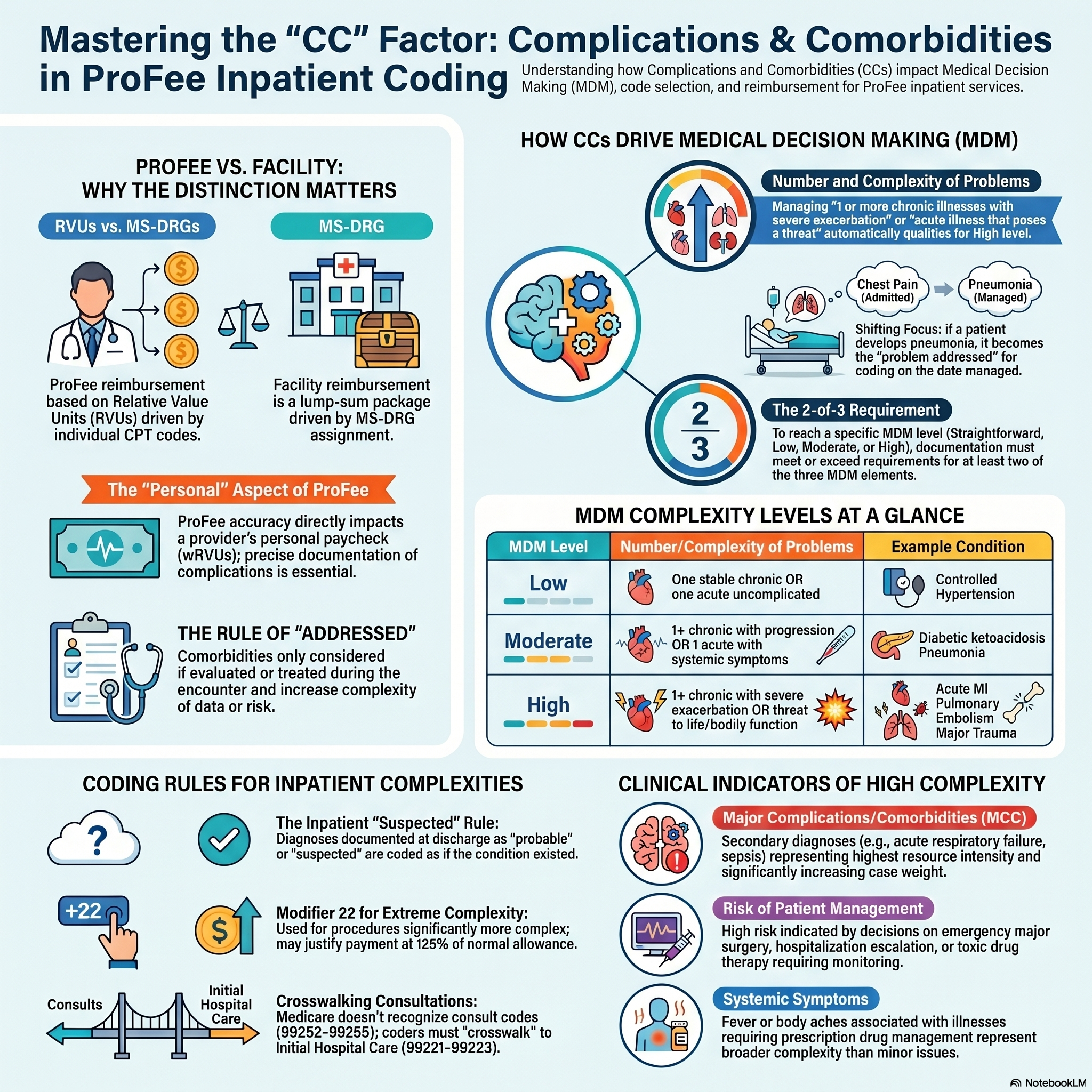
📋 Core CC/MCC Principles (All Specialties)
Documentation Standards
- Principal diagnosis: Condition established after study as the reason for admission
- Other diagnoses: Must affect patient care by requiring clinical evaluation, therapeutic treatment, diagnostic procedures, extended LOS, or increased nursing care
- Clinical validation: Provider documentation must support the diagnosis; coders cannot assign based on clinical criteria alone
- Query when unclear: Use clinical validation queries to bridge gaps between documentation and coding requirements
FY 2026 Updates
- CMS added 20 new ICD-10-CM codes to the MCC list and 111 new codes to the CC list for FY 2026 (Tables 6I/6J)
- FY 2026 ICD-10-CM overall: 487 new diagnosis codes, 38 revised, 28 deleted — a net increase over FY 2025’s 252 new codes
- MS-DRG Grouper updated to v43.0, effective October 1, 2025; a mid-year update (v43.1, 80 new ICD-10-PCS codes) took effect April 1, 2026
- CMS deleted MS-DRGs 077-079 (Hypertensive Encephalopathy), 294-295 (Deep Vein Thrombophlebitis), and 509 (low-volume arthroscopy) as part of the FY 2026 low-volume DRG consolidation — none fall within PMR/Urology/ENT/Ophthalmology ranges, but coders should scrub old DRG references from CDI tools
- Largest volume of new codes: Chapter 12 (Skin) — 112 new non-pressure chronic ulcer codes by site/severity — and Chapter 7 (Eye) — 17 new codes including 9 site-specific eyelid/blepharitis codes (replacing general H01.8) and new Demodex-related and neovascular secondary glaucoma codes
The Nine Guiding Principles for CC/MCC Analysis
- Represents end-of-life/near death or advanced systemic decompensation
- Denotes organ system instability or failure
- Involves chronic illness with susceptibility to exacerbations
- Serves as marker for advanced disease across multiple comorbidities
- Reflects systemic impact
- Postoperative/post-procedure condition impacting recovery
- Requires higher level of care (ICU, intensive monitoring, extended LOS)
- Impedes patient cooperation or care management
- Recent change in best practice affecting resource use
Pro Tip
Do not confuse principal diagnosis with primary diagnosis. Principal diagnosis is the reason for the inpatient admission after study; primary diagnosis sequencing is an outpatient concept .
♿ Physical Medicine & Rehabilitation (PMR/IRF)
Unique Framework: IRF-PAI vs. UB-04
Inpatient Rehabilitation Facilities use two parallel coding systems:
- IRF-PAI (Inpatient Rehabilitation Facility Patient Assessment Instrument): Determines CMG (Case-Mix Group) payment under IRF PPS
- UB-04 claim form: Uses MS-DRGs like acute care hospitals
Critical Documentation Requirements
✅ Pre-admission screening (PAS) documenting medical necessity
✅ Reasonable expectation of active participation in intensive rehab
✅ Need for multidisciplinary team (PT/OT/SLP minimum 3 hrs/day, 5 days/week)
✅ Physician supervision and face-to-face visits
✅ Comorbidities sequenced in FIRST 10 positions on IRF-PAI to impact payment
IRF-PAI Comorbidity Coding Tips
- Use ICD-10-CM codes for comorbid conditions in Item #24
- Only comorbidities meeting regulatory criteria (42 CFR 412.29) count toward case-mix adjustment
- Arthritis comorbidities: Must meet specific regulatory requirements to qualify for IRF classification
- Complications during stay: Code in Item #47 using ICD-10-CM (these are POA=N)
Common CC/MCC in PMR Patients
| Condition | Typical CC/MCC Status | Coding Consideration |
|---|---|---|
| Pressure ulcer Stage III/IV | MCC | Document stage, location, laterality |
| Malnutrition, severe | MCC | Must meet ASPEN/AND criteria; provider must document “severe” |
| Acute renal failure with ATN | MCC | Differentiate from chronic kidney disease |
| Encephalopathy, metabolic/toxic | MCC | Specify type; link to underlying cause |
| Sepsis with organ dysfunction | MCC | Document organ dysfunction explicitly |
| COPD with acute exacerbation | CC | Must document “acute exacerbation” |
| Chronic kidney disease Stage IV/V | CC | Document stage; link to etiology if known |
IRF-Specific Pitfall
A comorbidity assigned to a payment tier must be sequenced within the first 10 comorbidities on the IRF-PAI to be reported and impact reimbursement .
FY 2026 Update — Non-Pressure Chronic Ulcers
Don’t confuse pressure ulcers (L89.-, coded above) with non-pressure chronic ulcers (L97/L98), which got 112 new site- and severity-specific codes for FY 2026 — new anatomical subcategories now exist for sites like the flank, abdomen, chest, neck, groin, and upper limb that previously had no dedicated code. PMR patients with diabetic, venous, or arterial ulcers may now qualify for more specific — and potentially higher-weighted — CC/MCC codes than the “unspecified site” defaults used in prior years .
🚽 Urology Inpatient Coding
Key MS-DRG Families (MDC 11: Kidney/Urinary Tract)
┌────────────────────────────────────────────┐
│ SURGICAL DRGs                             │
├────────────────────────────────────────────┤
│ 650-651: Kidney transplant ± hemodialysis │
│ 652: Kidney transplant                     │
│ 653-655: Major bladder procedures         │
│ 656-661: Kidney/ureter procedures         │
│ 662-664: Minor bladder procedures         │
│ 665-667: Prostatectomy                    │
│ 668-670: Transurethral procedures         │
│ 671-672: Urethral procedures              │
│ 673-675: Other kidney/urinary procedures  │
├────────────────────────────────────────────┤
│ MEDICAL DRGs                              │
├────────────────────────────────────────────┤
│ 682-684: Renal failure                    │
│ 686-688: Kidney/urinary neoplasms         │
│ 689-690: Kidney/urinary infections        │
│ 693-694: Urinary stones                   │
│ 695-696: Signs/symptoms                  │
│ 697: Urethral stricture                   │
│ 698-700: Other kidney/urinary diagnoses   │
└────────────────────────────────────────────┘
Urology-Specific CC/MCC Examples
WARNING
Dollar figures below are illustrative national averages and shift with each year’s IPPS Final Rule (relative weights + wage index). Verify current amounts against your facility’s active Pricer before using in appeals or CDI education.
| Procedure/Condition | DRG w/ MCC | DRG w/ CC | DRG w/o CC/MCC | Common MCC/CC Triggers |
|---|---|---|---|---|
| Minor bladder procedures | 662: $22,278 | 663: $11,062 | 664: $7,618 | Sepsis, acute renal failure, severe malnutrition |
| Penis procedures | 709: $16,934 | — | 710: $10,196 | Post-op infection, hemorrhage, DVT/PE |
| Transurethral prostatectomy | 668: $10,940 | 669: $7,694 | 670: $7,694 | Acute urinary retention with renal impairment |
| Kidney/ureter procedures (non-neoplasm) | 673: $30,574 | 674: $17,017 | 675: $11,944 | Acute pyelonephritis with sepsis, obstruction |
High-Yield Urology CC/MCC Diagnoses
MCC Examples
N17.9  Acute kidney failure, unspecified (if with ATN: MCC)
A41.9  Sepsis, unspecified organism
E87.0  Hyperosmolality and hypernatremia (if diabetic ketoacidosis)
L89.3- Pressure ulcer, stage 4 (MCC); L89.2- stage 3 (MCC)
R65.20 Severe sepsis without septic shock

CC Examples
N18.4  Chronic kidney disease, stage 4
N18.5  Chronic kidney disease, stage 5
J44.1  COPD with acute exacerbation
E44.0  Moderate protein-calorie malnutrition
I50.9  Heart failure, unspecified (chronic)
Documentation Pearls for Urology
- “w/MCC” in DRG title = at least one secondary diagnosis designated as MCC by CMS
- Prosthetic device complications: Use T83.4- (penile prosthesis) or T83.5- (urinary sphincter) with 7th character A (initial encounter) for mechanical complications or infections
- Post-op urinary retention: Document if acute vs. chronic; link to procedure if applicable
- Hematuria: Specify cause (post-procedural, neoplasm, infection) to avoid unspecified codes
Reimbursement Impact
Adding a single MCC can increase MS-DRG reimbursement by 15,000+ depending on the base DRG, though exact impact depends on the wage index and current relative weights — verify against the active Pricer rather than relying on fixed dollar figures.
FY 2026 Genitourinary Additions
New Chapter 14 (N00-N99) codes for FY 2026 cover immune complex membranoproliferative glomerulonephritis (IC-MPGN), hereditary/APOL1-mediated nephropathy, and genetic susceptibility/family history indicators for kidney disease. Watch for these on complex nephrology-comanaged urology admissions — they add specificity beyond the existing N18.4/N18.5 CKD staging codes already in your reference table .
👂 Otolaryngology (ENT) Inpatient Coding
Common Inpatient ENT Scenarios & DRGs
| Clinical Scenario | Typical MDC | Key CC/MCC Considerations |
|---|---|---|
| Airway compromise/post-op edema | MDC 3 (ENT) | Respiratory failure (MCC), aspiration pneumonia (MCC) |
| Complex head/neck cancer resection | MDC 3 or 17 | Malnutrition (MCC if severe), sepsis, wound dehiscence |
| Epistaxis with transfusion | MDC 3 | Acute blood loss anemia (CC), coagulopathy |
| Post-tonsillectomy hemorrhage | MDC 3 | Hypovolemia, airway intervention |
| Skull base surgery complications | MDC 1 (Neuro) or 3 | CSF leak with meningitis (MCC), cranial nerve injury |
ENT-Specific CC/MCC Documentation Tips
✅ Airway complications: Document stridor, laryngeal edema, need for reintubation
✅ Aspiration events: Specify "aspiration pneumonia" (J69.0) vs. "chemical pneumonitis" (J68.0)
✅ Post-op infections: Use T81.4- (infection following procedure) + organism code (B95-B96)
✅ Bleeding complications: Quantify blood loss; document transfusion requirements
✅ Neurologic deficits: Specify cranial nerve involved; document functional impact
High-Yield ICD-10-CM Codes for ENT CC/MCC
MCC Candidates
J69.0   Pneumonitis due to inhalation of food/vomit
J96.00  Acute respiratory failure, unspecified
A41.9   Sepsis, unspecified
G93.1   Anoxic brain damage, not elsewhere classified
L89.3-  Pressure ulcer, stage 4 (if immobilized post-op)

CC Candidates
D62    Acute posthemorrhagic anemia
E44.0  Moderate protein-calorie malnutrition
J44.1  COPD with acute exacerbation
I26.90 Pulmonary embolism without acute cor pulmonale
R13.10 Dysphagia, unspecified (if affecting nutrition/therapy)
Query Triggers for ENT Documentation
- Provider documents “infection” post-op but doesn’t specify surgical site infection vs. pneumonia
- “Bleeding” documented without quantification or intervention
- “Respiratory distress” without specification of failure vs. insufficiency
- Malnutrition mentioned but severity not documented (critical for MCC capture)
ENT Coding Alert
Coders who fail to read the entire operative report may incorrectly report tissue removal codes that don’t include excision of lesions or fail to capture complication codes .
👁️ Ophthalmology Inpatient Coding
Important Context
Ophthalmology is predominantly outpatient
True inpatient admissions are rare and typically involve:
- Severe orbital cellulitis with systemic involvement
- Traumatic globe rupture with associated injuries
- Endophthalmitis with sepsis
- Complex oculoplastic reconstruction post-trauma
- Neuro-ophthalmologic emergencies (e.g., giant cell arteritis with vision loss)
Relevant MS-DRGs (MDC 2: Eye Disorders)
DRG 113-125: Diseases & Disorders of the Eye
• 121: Acute major eye infections WITH CC/MCC
• 122: Acute major eye infections WITH CC
• 123: Acute major eye infections WITHOUT CC/MCC
• 124-125: Other eye procedures with/without CC/MCC
Ophthalmology-Specific CC/MCC Considerations
| Condition | CC/MCC Potential | Documentation Requirement |
|---|---|---|
| Orbital cellulitis with abscess | MCC if sepsis/organ dysfunction | Document systemic signs, imaging findings |
| Endophthalmitis post-op | CC/MCC if systemic involvement | Specify organism; link to procedure if applicable |
| Traumatic hyphema with glaucoma | CC if acute angle closure | Document IOP, visual acuity impact |
| Giant cell arteritis with vision loss | MCC if stroke/TIA co-occurs | Document ESR/CRP, temporal artery findings |
| Chemical burn with corneal perforation | CC if requiring surgery | Document depth, laterality, visual prognosis |
High-Yield ICD-10-CM Codes
MCC Candidates (when systemic/organ involvement)
H05.011 Acute orbital cellulitis, right eye (with sepsis: MCC)
H44.001 Purulent endophthalmitis, unspecified eye, right
H21.81  Hyphema of iris and ciliary body (if causing acute glaucoma)
G45.9   Transient cerebral ischemic attack, unspecified (if GCA-related)
A41.9   Sepsis, unspecified (if orbital infection systemic)

CC Candidates
H40.1110 Primary open-angle glaucoma, right eye, stage unspecified
H16.011 Corneal ulcer, right eye
H53.121 Subjective visual disturbance, right eye
E11.319 Type 2 diabetes mellitus with unspecified diabetic retinopathy
FY 2026 Ophthalmology Chapter Updates
✅ 9 new site-specific eyelid inflammation codes REPLACE the general H01.8 code
✅ New Demodex blepharitis codes — pair with new acariasis code B88.0- when
   Demodex mites are the documented cause (responsible for 70%+ of blepharitis cases)
✅ New codes for neovascular secondary angle closure glaucoma (severe secondary
   glaucoma subtype — document underlying cause, e.g., ischemic retinopathy)
✅ New thyroid eye disease codes — useful for orbital involvement tied to
   Graves' disease when systemic thyroid status also drives CC/MCC capture
Inpatient Relevance
Most of these new codes describe outpatient-managed eye disease and won’t independently drive CC/MCC status on an inpatient claim. They matter most when the eye condition is the reason a systemic complication (orbital cellulitis with sepsis, post-op endophthalmitis, etc.) is being treated — code the systemic complication with full specificity, and use the new eye-chapter codes to complete the clinical picture .
Academy of Ophthalmology Resources
- ICD-10-CM for Ophthalmology: The Complete Reference (updated annually)
- Subspecialty decision trees: Anterior uveitis, AMD, diabetes, etc.
- Quick-reference guides: Cornea, Glaucoma, Retina, Uveitis
- Coding contact: coding@aao.org for complex scenarios
Ophthalmology Coding Nuance
Most eye conditions are managed outpatient. For inpatient coding, focus on systemic complications (sepsis, respiratory failure, malnutrition) that drive CC/MCC status rather than the eye condition itself .
🔍 Universal CC/MCC Documentation Checklist
## For EVERY secondary diagnosis, ask:
□ Is the condition clinically significant?
□ Did it require:
  □ Clinical evaluation beyond routine care?
  □ Therapeutic treatment (meds, procedure, therapy)?
  □ Diagnostic procedures (labs, imaging, consults)?
  □ Extended length of stay?
  □ Increased nursing care/monitoring?
□ Is the provider's diagnostic statement clear and specific?
□ Is the condition present on admission (POA=Y) or developed during stay (POA=N)?
□ Does documentation support the severity level (e.g., "severe" malnutrition, "acute" exacerbation)?
□ Are laterality, stage, and specificity documented per ICD-10-CM requirements?
📚 Key References for Your Vault
- CMS MS-DRG Definitions Manual v43.0 - Official DRG/CC/MCC logic (v43.1 mid-year update effective 4/1/2026)
- ICD-10-CM Official Guidelines FY 2026 - Coding rules & POA guidance, effective 10/1/2025
- IRF-PAI Manual v4.2 - PMR-specific assessment & comorbidity rules
- AAO ICD-10-CM for Ophthalmology - Eye-specific coding guidance
- ADL Data CC/MCC Checklist - Abbreviated CMS list of qualifying diagnoses
- CMS Table 6I 6J FY2026 - Official additions/deletions to MCC and CC lists
Bottom Line
CC/MCC capture is documentation-driven, not coder-driven. Your role is to:
- Ensure provider documentation supports clinical significance and severity
- Apply ICD-10-CM guidelines accurately
- Query when documentation is incomplete or conflicting
- Sequence diagnoses per UHDDS and MS-DRG logic
When documentation is complete and specific, CC/MCC assignment follows naturally—and reimbursement reflects the true complexity of care [].
A single specific diagnosis code is categorized by Medicare as either a CC, an MCC, or neither—it cannot be both.
However, a patient can certainly have multiple different secondary conditions on their claim where some are CCs and others are MCCs. When this happens, the MS-DRG grouping system will use the highest severity condition present (the MCC) to determine the final hospital payment tier.
*Last updated: 2026-07-17 — reviewed for FY 2026 ICD-10-CM (effective 10/1/2025) and MS-DRG v43.0/v43.1*