🧬 ICD-10 CM Q07.03 — Arnold-Chiari Syndrome With Spina Bifida and Hydrocephalus
Billable Code Confirmed
ICD-10 CM Q07.03 is a fully specified, six-character billable code effective for FY2026 (10/1/2025–9/30/2026). The sixth character “3” captures the combined presentation — both spina bifida and hydrocephalus — distinguishing it from the three other Q07.0- subcategory codes that capture each finding alone or neither.
Non-Billable Parent Codes
- Q07 (Other congenital malformations of nervous system) — category level, always requires a fourth character.
- Q07.0 (Arnold-Chiari syndrome) — requires a fifth and sixth character to specify presence/absence of spina bifida and hydrocephalus; cannot be billed alone.
Clinical Context
The selection between Q07.00, Q07.01, Q07.02, and Q07.03 hinges entirely on whether the associated spina bifida (myelomeningocele) and hydrocephalus are documented as present. Coders must not assume — if the provider documents “Chiari II malformation” without stating the co-occurring findings, query rather than defaulting to Q07.03.
Code Classification
ICD-10 CM Q07.03 is a diagnosis code (ICD-10-CM), not a procedure code. It reflects a structural congenital anomaly and does not itself drive procedural reimbursement — associated CPT/HCPCS codes are required to bill any surgical intervention.
🔍 Code Description
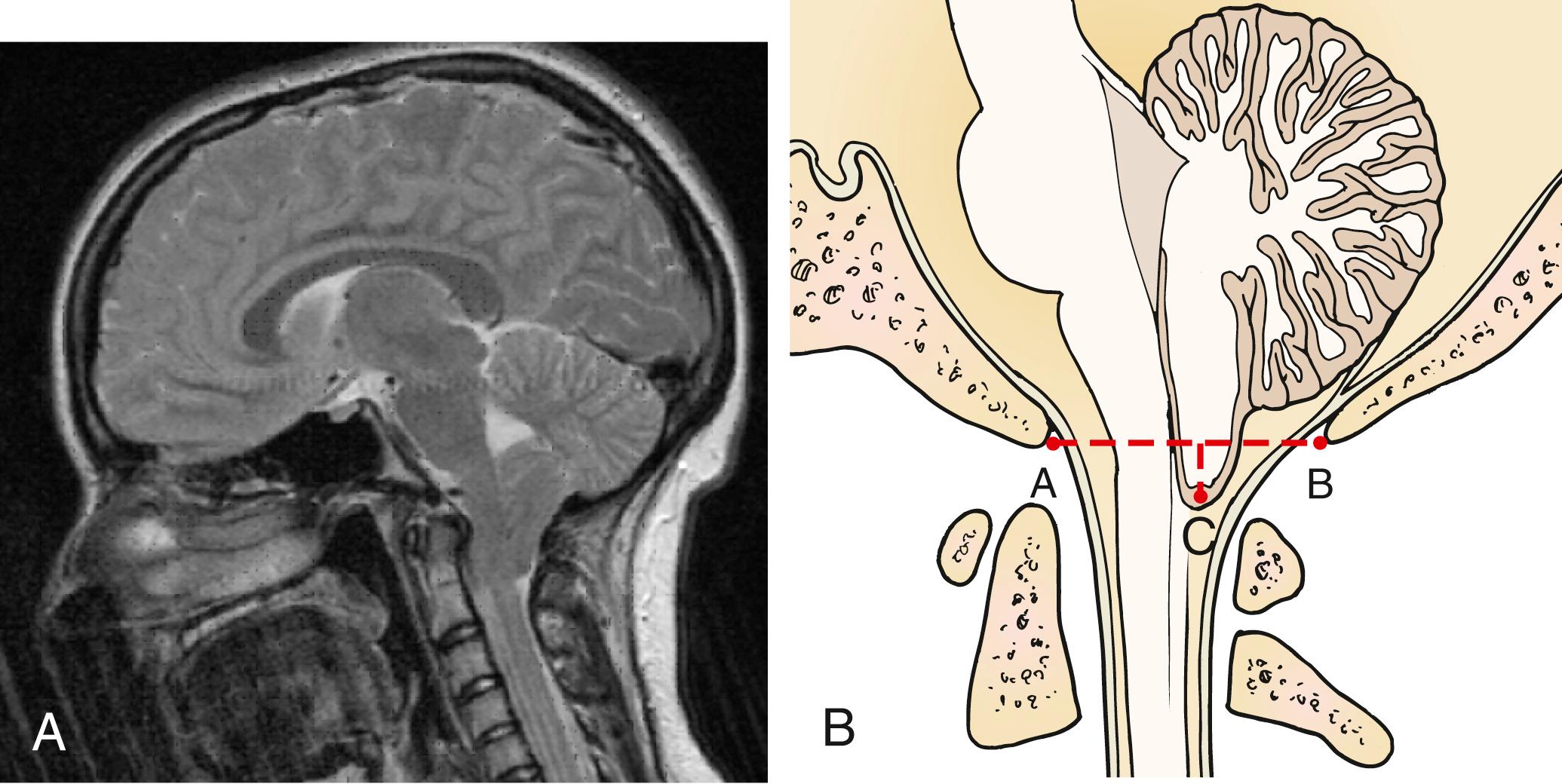
Arnold-Chiari syndrome, also referred to clinically as Chiari II malformation, is a congenital hindbrain anomaly in which the cerebellar tonsils and vermis herniate downward through the foramen magnum into the cervical spinal canal. Q07.03 specifically captures the combined presentation in which this hindbrain herniation coexists with an open neural tube defect — most commonly Q07.01-type myelomeningocele — and obstructive hydrocephalus resulting from disrupted cerebrospinal fluid flow at the level of the fourth ventricle or aqueduct.
This combination is the classic presentation seen in infants born with myelomeningocele, where nearly all affected neonates demonstrate some degree of Chiari II herniation, and a majority go on to develop hydrocephalus requiring ventricular shunting. Distinguishing Q07.03 from the standalone codes Q07.00 and Q07.02 matters for both clinical accuracy and DRG assignment, since the combined diagnosis often correlates with a higher acuity of neurosurgical intervention and longer NICU or inpatient stays.
🌳 Code Tree / Hierarchy
Q07 Other congenital malformations of nervous system ❌ Non-billable
│
├── Q07.0 Arnold-Chiari syndrome ❌ Non-billable
│ │
│ ├── Q07.00 Arnold-Chiari syndrome without spina bifida or hydrocephalus ✅ Billable
│ ├── Q07.01 Arnold-Chiari syndrome with spina bifida ✅ Billable
│ ├── Q07.02 Arnold-Chiari syndrome with hydrocephalus ✅ Billable
│ └── Q07.03 Arnold-Chiari syndrome with spina bifida and hydrocephalus ◀ THIS CODE ✅ Billable
│
├── Q07.8 Other specified congenital malformations of nervous system ✅ Billable
│
└── Q07.9 Congenital malformation of nervous system, unspecified ✅ Billable
Specificity Matters for DRG Weight
Tip
Because Q07.03 already bundles spina bifida and hydrocephalus into one code, do not separately report a standalone spina bifida code (Q05 family) or acquired hydrocephalus code (G91 family) for the same congenital presentation — that would be redundant coding of findings already captured.
✅ Includes
- Arnold-Chiari malformation, type II, with combined spina bifida (myelomeningocele) and hydrocephalus — the classic pediatric neurosurgical presentation captured by Q07.03.
- Chiari II malformation with obstructive/non-communicating hydrocephalus secondary to hindbrain crowding at the foramen magnum, when spina bifida is also documented.
❌ Excludes
Excludes 1
Q01.- — Arnold-Chiari syndrome, type III: a distinct, more severe malformation involving cervical/occipital encephalocele — mutually exclusive from type II captured under Q07.0-. Q04.8 — Other specified congenital malformations of brain, which includes Arnold-Chiari syndrome type IV (cerebellar hypoplasia without herniation) — a fundamentally different malformation pattern than the herniation seen in type II.
Common Excludes 1 Error
Coders sometimes default to Q07.03 whenever “Chiari malformation” appears in documentation without confirming the type. Always verify the provider has specified type II (or documented findings consistent with it — tonsillar/vermian herniation with myelomeningocele) before assigning Q07.03, rather than type III or IV, which route to completely different code categories.
Excludes 2
No Excludes 2 notes are published for Q07.03 in the FY2026 tabular.
📋 Clinical Overview
Distinguishing the Four Q07.0- Subcategories
These four codes differ only in which two additional congenital findings — spina bifida and hydrocephalus — are documented alongside the Chiari II herniation itself. Correct code selection requires the operative note, imaging report, or attending documentation to explicitly confirm or rule out each component.
| Feature | Q07.03 | Q07.01 | Q07.02 |
|---|---|---|---|
| Spina bifida present | Yes | Yes | No |
| Hydrocephalus present | Yes | No | Yes |
| Typical clinical setting | Newborn with myelomeningocele repair plus shunt placement in the same admission or shortly after. | Newborn undergoing isolated myelomeningocele closure without ventricular enlargement. | Chiari II identified with hydrocephalus but no open neural tube defect (rarer presentation). |
CDI Trigger
If a neonatal chart documents “myelomeningocele repair” and “VP shunt” in the same admission but the diagnosis list only states “Chiari malformation,” this is a strong CDI query trigger — the documentation almost certainly supports Q07.03 rather than the vaguer Q07.0- parent or an unspecified code.
Manifestations & Symptom Burden
- Hindbrain herniation signs: brainstem compression can produce apneic spells, stridor, or dysphagia in neonates due to lower cranial nerve involvement.
- Hydrocephalus signs: rapidly increasing head circumference, bulging fontanelle, split sutures, and irritability in the newborn period.
- Motor/sensory deficits: related to the level of the myelomeningocele defect, typically lower-extremity weakness or sensory loss below the lesion level.
- Long-term sequelae: tethered cord, syringomyelia, and recurrent shunt malfunction are common downstream complications requiring lifelong surveillance.
Tip
Code any acute complication (e.g., shunt malfunction, syrinx) separately using the appropriate acquired condition code — Q07.03 documents the underlying congenital anomaly, not its downstream complications.
💰 HCC Risk Adjustment
ICD-10 CM Q07.03 is not currently mapped to a CMS-HCC category under the V28 adult risk-adjustment model used for Medicare Advantage. Since this is overwhelmingly a neonatal/pediatric diagnosis, it rarely appears on adult MA risk-adjustment claims; when it does (an adult survivor with lifelong Chiari II sequelae), no RAF value is captured from this code alone. If the patient carries active neurologic sequelae — such as paraplegia or neurogenic bladder — code those manifestations separately, as several do carry HCC weight.
🏥 MS-DRG Assignment
| DRG | Title | Context |
|---|---|---|
| 091 | Other disorders of nervous system with MCC | Adult/pediatric non-neonatal admission with a qualifying major complication/comorbidity. |
| 092 | Other disorders of nervous system with CC | Same, with a qualifying CC instead of MCC. |
| 093 | Other disorders of nervous system without CC/MCC | No qualifying secondary diagnosis captured. |
| 791 | Prematurity with major problems | Applies when reported on a preterm newborn’s own record. |
| 793 | Full term neonate with major problems | Applies when reported on a term newborn’s own record — the most common real-world scenario for this code. |
Sequencing note: on a newborn’s own chart, neonatal DRG logic (791/793) takes precedence over the general nervous-system DRGs (091–093), so verify which encounter type you’re coding before finalizing the grouper path. A common pitfall is capturing this diagnosis on the maternal delivery record — Chapter 17 congenital codes are explicitly excluded from maternal records and belong only on the newborn’s own chart.
- NCD/LCD applicability: No national coverage determination applies to the diagnosis code itself. Coverage determinations instead attach to the procedures performed (e.g., ventricular shunt placement, myelomeningocele closure) and are governed by the relevant surgical LCDs for your MAC jurisdiction — verify current Noridian JE/JF neurosurgery LCDs if billing the associated procedures.
🔗 Related ICD-10-CM Codes
Same Q07.0 subcategory (laterality of findings, not anatomic laterality):
- Q07.00 — Arnold-Chiari syndrome without spina bifida or hydrocephalus
- Q07.01 — Arnold-Chiari syndrome with spina bifida
- Q07.02 — Arnold-Chiari syndrome with hydrocephalus
- Q07.8 — Other specified congenital malformations of nervous system
- Q07.9 — Congenital malformation of nervous system, unspecified
Related congenital/complication codes:
- Q05.5 — Cervical spina bifida with hydrocephalus (isolated spina bifida with hydrocephalus, not Chiari-specific)
- G91.1 — Obstructive hydrocephalus (acquired, code only if distinct from the congenital presentation)
- Q06.4 — Hydromyelia
- G95.20 — Unspecified cord compression (if tethered cord develops later)
🛠️ Commonly Associated CPT Codes
- 61343 — Craniectomy, suboccipital with cervical laminectomy for decompression of medulla and spinal cord, with or without dural graft, for Chiari malformation with or without traction: the primary posterior fossa decompression procedure for symptomatic Chiari II.
- 62223 — Creation of shunt, ventriculo-peritoneal or ventriculo-atrial: used for initial hydrocephalus management in the newborn.
- 63700 — Repair of meningocele; less than 5 cm diameter: for smaller myelomeningocele defects.
- 63702 — Repair of meningocele; larger than 5 cm diameter: for larger defects.
- 63709 — Repair of dural/cerebrospinal fluid leak or pseudomeningocele, with laminectomy: for postoperative CSF leak complications.
- 62201 — Neuroendoscopy, intracranial, for placement or replacement of ventricular catheter and connection to shunt system or external drainage; without use of stereotactic guidance — occasionally used as an alternative shunt-placement approach.
🏷️ Modifier Reference
| Modifier | Name | When to Apply |
|---|---|---|
| -58 | Staged | Applies when myelomeningocele closure and shunt placement occur as planned, staged procedures during the same global period rather than the same operative session. |
| -78 | Return to OR | Applies if the patient returns unplanned to the OR for a related complication, such as a CSF leak or early shunt failure, during the postoperative period. |
| -79 | Unrelated Procedure | Applies if an unrelated procedure is performed by the same surgeon during the postoperative period of the original repair or shunt placement. |
| -51 | Multiple Procedures | Applies when both a meningocele repair and a shunt placement are performed in the same operative session by the same surgeon. |
| -59 | Distinct Service | Applies to distinguish separately identifiable procedural components that might otherwise be considered bundled under NCCI edits. |
| -52 | Reduced Services | Applies if a planned procedure, such as shunt placement, is reduced in scope at the surgeon’s discretion. |
| -53 | Discontinued | Applies if the procedure is discontinued after induction of anesthesia due to the patient’s clinical instability. |
| -25 | Significant E/M | Applies if a significant, separately identifiable E/M service is furnished by the same physician on the day of a minor shunt-related procedure. |
NCCI Bundling Considerations
Suboccipital decompression (61343) and shunt placement (62223) performed in the same session are generally separately billable when medically necessary and distinctly documented, but always verify current NCCI PTP edit pairs before appending -59 or an X{EPSU} modifier, since bundling edits are updated quarterly.
🔬 ICD-10-PCS Crosswalk
- 00N30ZZ — Release Cerebral Ventricle, Open Approach: reflects surgical decompression addressing obstructed CSF flow associated with the hydrocephalus component.
- 00160J6 — Bypass Cerebral Ventricle to Peritoneal Cavity with Synthetic Substitute, Open Approach: reflects VP shunt placement for the hydrocephalus component.
- 00Q00ZZ — Repair Brain, Open Approach: may apply to posterior fossa decompression procedures addressing the herniated cerebellar tonsils.
- 00QU0ZZ — Repair Spinal Meninges, Open Approach: reflects surgical closure of the associated myelomeningocele defect.
💊 Coding Scenarios and Examples
Example 1
Clinical Scenario: A term newborn is delivered with an open lumbar myelomeningocele identified prenatally. Postnatal MRI confirms Chiari II malformation with tonsillar herniation and moderate ventriculomegaly. The neurosurgery team performs myelomeningocele closure on day of life 1 and places a ventriculoperitoneal shunt on day of life 5 during the same admission for progressive hydrocephalus.
| Field | Code | Rationale |
|---|---|---|
| CPT | 63702 | Meningocele repair, larger than 5 cm diameter, performed on day of life 1. |
| CPT 2 | 62223--58 | Staged VP shunt placement performed later in the same admission for progressive hydrocephalus. |
| PDx | Q07.03 | Both spina bifida and hydrocephalus are explicitly documented alongside the Chiari II finding. |
Tip
Example 2
Clinical Scenario: A 6-week-old infant, previously repaired for myelomeningocele with documented Chiari II and hydrocephalus, is readmitted with vomiting and lethargy. Imaging confirms shunt malfunction requiring urgent shunt revision.
| Field | Code | Rationale |
|---|---|---|
| CPT | 62230 (not wikilinked — verify current CPT descriptor before use) | Represents shunt revision; confirm exact code against 2026 CPT manual before billing. |
| PDx | Q07.03 | Underlying congenital diagnosis remains active and relevant to the readmission. |
| Sec Dx | T85.02XA | Mechanical complication of ventricular shunt, initial encounter — captures the acute reason for readmission. |
Tip
The underlying Q07.03 diagnosis should still be reported as a secondary diagnosis on this readmission since it remains clinically relevant to the shunt complication, even though it is not the reason for this specific encounter.
Example 3
Clinical Scenario: A prenatal ultrasound and fetal MRI at 24 weeks gestation identify findings consistent with Chiari II malformation, open spina bifida, and ventriculomegaly. The infant is delivered at 36 weeks and the diagnosis is confirmed postnatally, with hydrocephalus requiring monitoring but not immediate shunting.
| Field | Code | Rationale |
|---|---|---|
| CPT | N/A | No procedure performed during this encounter — diagnostic confirmation only. |
| PDx | Q07.03 | Both spina bifida and hydrocephalus are confirmed on postnatal evaluation. |
Tip
Even without an immediate procedural intervention, Q07.03 should be captured as principal diagnosis on the newborn’s own record once both components are clinically confirmed, since this drives neonatal DRG assignment (793, if term).
⚠️ Coding Pitfalls and Tips
- Pitfall 1: Assigning Q07.03 based on documentation of “Chiari malformation” alone without confirmation of both spina bifida and hydrocephalus; Tips: query the provider or review imaging/operative reports to confirm both components before finalizing the sixth character.
- Pitfall 2: Reporting this diagnosis on the maternal delivery record; Tips: Chapter 17 congenital codes are excluded from maternal records per ICD-10-CM guidelines — report only on the newborn’s own chart.
- Pitfall 3: Double-coding spina bifida or hydrocephalus separately alongside Q07.03; Tips: since Q07.03 already captures both findings, separate reporting of Q05 or G91 codes for the same congenital presentation is redundant.
- Pitfall 4: Misapplying neonatal DRGs (791/793) on an adult or older pediatric admission, or vice versa; Tips: confirm patient age and encounter context (own record vs. maternal record) before finalizing DRG assignment.
- Pitfall 5: Failing to separately code acute complications like shunt malfunction on readmission; Tips: report the congenital anomaly as secondary and the acute mechanical complication (T85 family) as principal on complication-driven readmissions.
- Pitfall 6: Confusing Chiari type II (Q07.0 family) with type III or type IV; Tips: verify the specific type documented, since types III and IV route to entirely different code categories (Q01.- and Q04.8) under the Excludes1 note.
📚 Sources
1. Centers for Medicare & Medicaid Services, National Center for Health Statistics. *ICD-10-CM 2026 Tabular List of Diseases and Injuries.* CMS/NCHS; 2025. 2. ICD10Data.com. *2026 ICD-10-CM Diagnosis Code Q07.03: Arnold-Chiari syndrome with spina bifida and hydrocephalus.* icd10data.com; 2025. 3. AAPC Codify. *ICD-10 Code for Arnold-Chiari syndrome with spina bifida and hydrocephalus - Q07.03.* aapc.com; 2026.Sources listed above correspond to superscript citations throughout this note. Verify all Medicare payment figures against your current CMS PFS Lookup tool and applicable MAC LCD prior to claim submission. Please use the latest AAPC/AHIMA Coding Books to verify each code within this note.